
Three “Personalities” of Granulation: Roundness, Hardness, and Efficiency
Step into a fertilizer production workshop, and you will notice an interesting phenomenon: while all these machines transform powder into granules, they each possess a distinct “personality.” The disc granulator acts like a patient sculptor; the double roller press granulator resembles a decisive road roller; and the new-type two-in-one organic fertilizer granulator is like an agile, versatile all-rounder. These three pieces of equipment represent three different approaches, each answering a fundamental question in fertilizer granulation: exactly what kind of granule do we want?
The disc granulator follows a “nurturing” approach. Its core component is a large, tilted disc. As material is fed in from above, it is subjected to the combined forces of centrifugal action, friction, and gravity, causing it to tumble repeatedly along a parabolic trajectory. Simultaneously, atomizing nozzles spray water or a binding agent onto the material’s surface; the moistened fine powder accumulates layer by layer—much like a snowball—and gradually grows in size. Once the granules reach the target diameter, they automatically spill over the disc’s edge. The disc’s tilt angle is typically adjustable between 30 and 60 degrees, and the rotation speed can be flexibly controlled via a variable frequency drive; a shallower angle and slower speed result in a longer residence time within the disc, producing larger granules. The granules produced by this method are round, uniform, and smooth-surfaced.
The double roller press granulator takes the exact opposite approach: “compression.” Two high-strength rollers rotating toward each other compress dry powder directly into a solid sheet, which is subsequently crushed and screened to yield the final granules. The entire process requires neither water nor heat, allowing the material’s moisture content to remain negligible. The resulting granules feature distinct compression marks on their cross-sections and are less perfectly round than those from a disc granulator; however, they possess high density and strength, making them resistant to crumbling during storage, transport, and mechanical spreading. More importantly, it eliminates the need for massive drying and cooling systems, resulting in a total production line energy consumption that is 30% to 50% lower than that of wet granulation. For “temperamental” formulations—such as compound fertilizers with high urea content—that are prone to deliquescence upon contact with water or melting when exposed to heat, roller extrusion is virtually the only viable option.
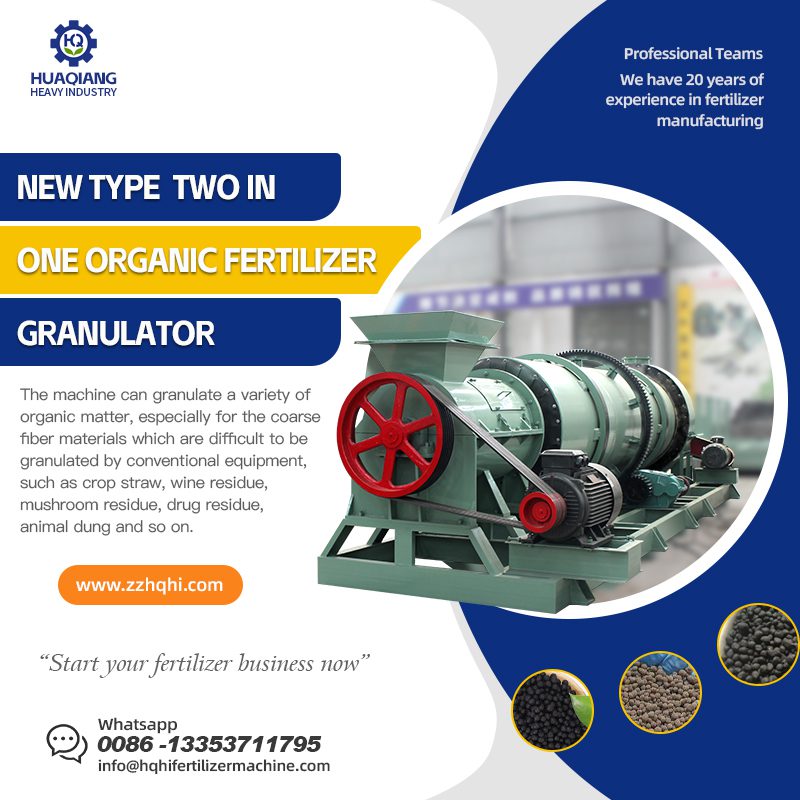
Meanwhile, a new type of “two-in-one” organic fertilizer granulator seeks a third path—”integration”—between mere “cultivation” (biological processing) and “compression.” This equipment combines the two core processes of mixing and granulation into a single machine. Designed to handle high-fiber materials like fermented livestock manure, crop stalks, and distillers’ grains, it employs high-speed internal stirring teeth to subject the material to intense shearing, kneading, and compression. This allows fine, powdery materials to undergo continuous mixing, granulation, and even spheronization (rounding) within the unit. Data indicates a pelletization rate of 92% to 95% and an energy consumption of just 18 to 22 kWh per ton—figures lower than traditional disc granulation and significantly lower than roller extrusion. Crucially, it can directly process wet materials with moisture content ranging from 10% to 35%, bypassing the need for pre-drying or fine pulverization. While traditional processes require a series of four separate machines—a stirring mixer, an elevator, a buffer bin, and a spheronizer—this two-in-one model accomplishes the entire two-step forming process with just a single unit. Clearly, this approach is far more practical and suited to real-world needs.