
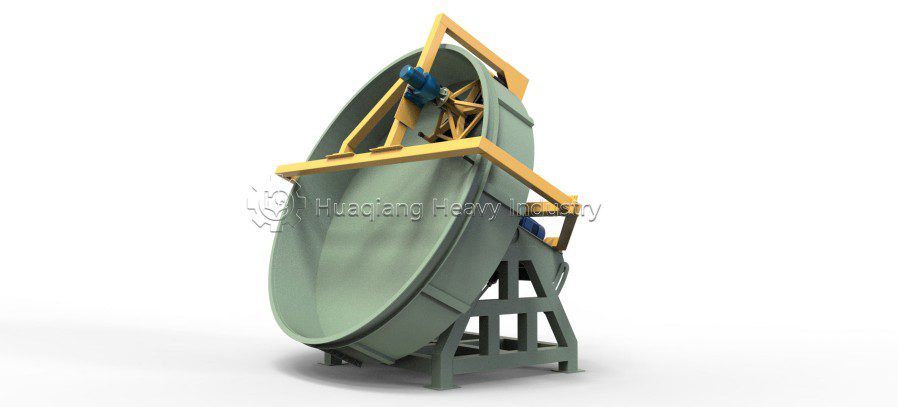
Disc Granulator
The disc granulator is a piece of disc-shaped equipment designed to transform powdery materials into spherical granules, serving as the core unit in pre-wetting pelletization systems. It plays an indispensable role in industries such as cement, compound fertilizer, and organic fertilizer production. The equipment produces granules of uniform size and low moisture content; the system features a simple structure, ease of control, and dust-free operation, enabling high-quality, high-yield, and low-energy production. Compared to other granulation processes, disc granulation for compound fertilizer offers significant economic advantages, reducing total investment costs by approximately 30%.
Structural composition of the equipment
From an engineering design perspective, the structural system of the disc granulator is as follows:
(I) Disc Assembly: Composed of the main disc body and vertically adjustable disc sections. The disc body features an integrated arc structure, with the bottom reinforced by multiple radial steel plates. The disc is mounted via a specially designed main shaft onto an adjustment plate fixed to the machine frame, ensuring operational stability.
(II) Drive Assembly: Includes the electric motor, gearbox, flexible belt, pinion gear, and main gear. The pinion meshes with the main gear fixed to the bottom of the disc to drive its rotation. The main gear undergoes high-frequency quenching to extend service life, and the drive system features a compact, efficient design.
(III) Angle Adjustment Assembly: The disc inclination angle is adjusted using angle shims or an adjustment screw rod; the adjustment range is 35°–55°, accommodating the granulation requirements of various materials.
(IV) Scraper Assembly: Equipped with a non-powered combined scraper for cleaning the disc edges and bottom. It requires no external power source, relying instead on the relative motion generated by the disc’s rotation to perform automatic cleaning.
(V) Base Assembly: Features a weighted design and robust structure, ensuring stable operation without the need for anchor bolts, while facilitating easy installation and relocation.
Application scope of the equipment
The disc granulator is suitable for a wide range of industries—including fertilizers (organic, compound, and blended fertilizers), pharmaceuticals, food processing, chemicals, and mining (coal dust, cement, iron ore pellets)—and can process various non-sticky or lightweight fine-powder materials. It has become a key piece of equipment for transforming waste into commercial fertilizer, particularly in the field of organic fertilizer resource utilization.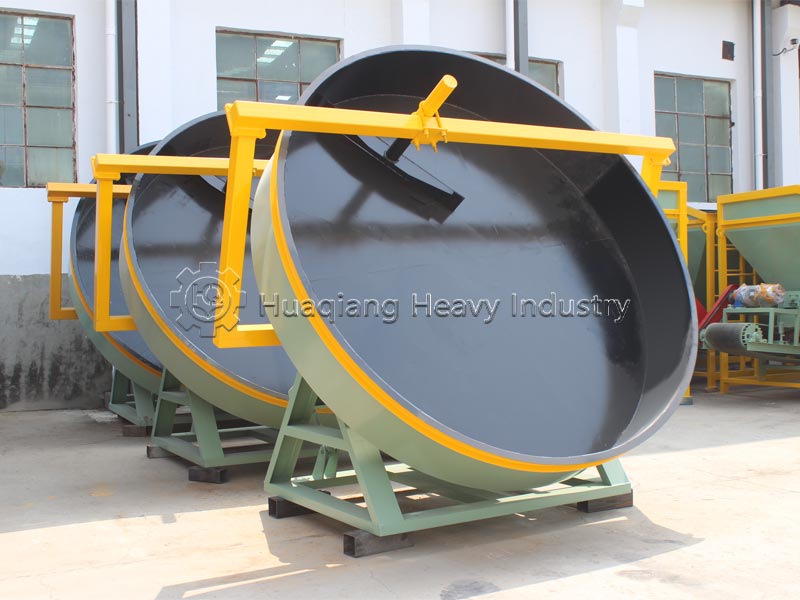
Raw materials for the equipment
The equipment demonstrates broad adaptability to various raw materials. Organic materials include livestock and poultry manure, food waste, industrial waste, crop stalks and fallen leaves, fermentation residues, and oilseed cakes/meals; chemical fertilizer materials include urea, ammonium chloride, ammonium sulfate, ammonium bicarbonate, ordinary superphosphate, triple superphosphate, monoammonium phosphate, diammonium phosphate, calcium-magnesium-phosphate fertilizer, and potassium chloride; and industrial materials include coal powder, cement, clinker, limestone, mineral powder, iron concentrate, and titanium dioxide.
The working principle of the equipment
The main motor drives a pulley and belt, transmitting power through a speed reducer to a pinion gear, which meshes with a large gear fixed to the base of the granulation pan. The large gear rotates the pan; as material enters, the continuous rotation combined with the action of a spray system causes the material to bind uniformly into spherical granules. An automatic cleaning device is installed in the upper section of the pan to prevent material from sticking to the walls, thereby ensuring continuous production.
Factors to Consider for Model Selection
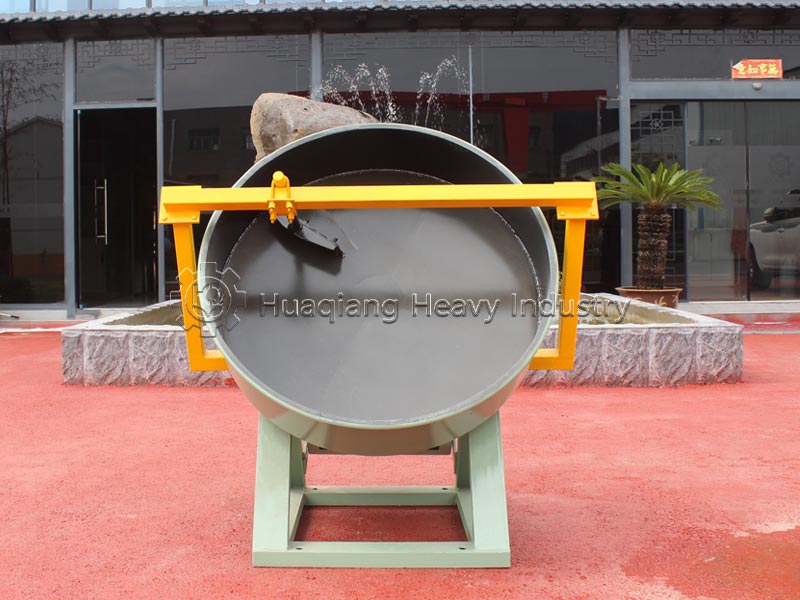
When selecting a disc granulator, users should comprehensively consider the following factors: production scale—determining equipment specifications based on daily processing capacity or annual output; raw material characteristics—including moisture content, particle size, and viscosity, as different materials require different equipment parameters; finished product requirements—specifications such as desired particle size and strength; site conditions—installation space, power supply configuration, and foundation load-bearing capacity; and investment budget—the full lifecycle costs covering equipment procurement, installation, and operation and maintenance.
Investment Benefit Analysis
Compared to other granulation processes, the disc granulator offers significant investment advantages. The equipment itself has relatively low manufacturing costs, a short installation period, low energy consumption during operation, and minimal maintenance expenses. Taking a small-to-medium-sized organic fertilizer production line as an example, using a disc granulator as the core granulation unit can reduce equipment investment by approximately 30% compared to extrusion or drum granulation methods; furthermore, the resulting granules are of superior quality and command higher market prices. The equipment operates reliably with a low failure rate, spare parts are reasonably priced, and overall operating costs are among the lowest in the industry.
Models and Specifications of Disc Granulators
| Fertilizer Disc Granulator Machine | |||||
| Model | Capacity(t/h) | Diameter(mm) | Side Height(mm) | Rotation Speed(r/min) | Motor Power(Kw) |
| ZL-500 | 0.05-0.15 | 500 | 150 | 25 | 1.5 |
| ZL-800 | 0.1-0.3 | 800 | 200 | 25 | 1.5 |
| ZL-1000 | 0.1-0.35 | 1000 | 250 | 25 | 2.2 |
| ZL-1200 | 0.1-0.35 | 1200 | 250 | 25 | 3 |
| ZL-1500 | 0.3-1 | 1500 | 300 | 18 | 3 |
| ZL-1800 | 0.5-1.2 | 1800 | 350 | 18 | 4 |
| ZL-2000 | 0.5-1.5 | 2000 | 400 | 18 | 5.5 |
| ZL-2500 | 1-2.5 | 2500 | 400 | 13.6 | 7.5 |
| ZL-2800 | 2-3 | 2800 | 500 | 13.6 | 11 |
| ZL-3000 | 2-3 | 3000 | 500 | 11 | 11 |
| ZL-3200 | 3-5 | 3200 | 500 | 10 | 11 |
| ZL-3600 | 3.5-6 | 3600 | 500 | 10 | 18.5 |