Solutions for Improving Pelletizing Rate in Disc Granulation Production Lines
Improving the pelletizing rate of disc granulation production lines involves optimizing four dimensions: raw materials, disc surface adjustment, spraying, and operational control. This can increase the pelletizing rate from 65%–75% to over 85%.
Raw material pretreatment is fundamental. Well-rotted organic fertilizer should be crushed to below 2mm, with a reasonable mix of coarse and fine powders. Fine powder should account for over 60% to act as the nucleus. Strictly control the feed moisture content to 18%–22%. Too high a moisture content will cause the pellets to stick to the disc and collapse, while too low a moisture content will make it difficult to agglomerate. Long fibers should be crushed beforehand to prevent them from becoming loose and failing to granulate. Agglomerated materials should be sieved and broken up to prevent large pieces from being directly fed into the disc.
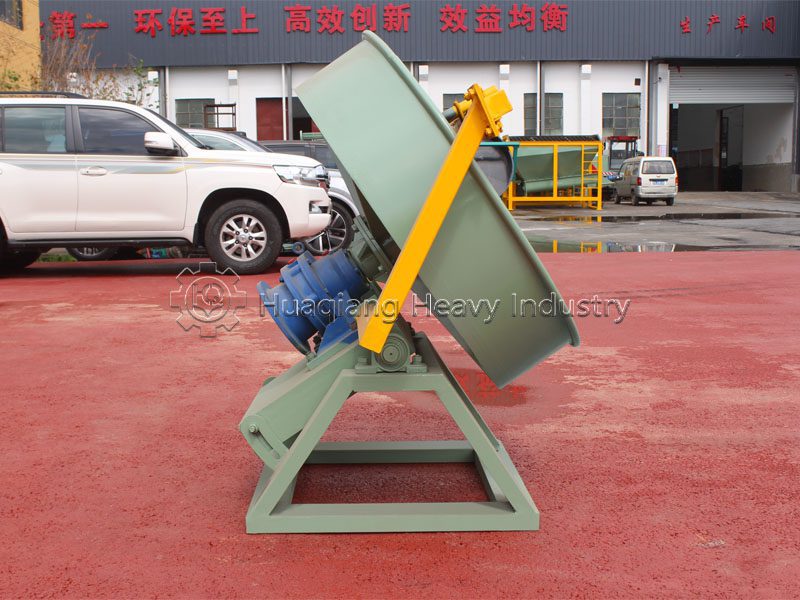
Precisely adjust the parameters of the disc granulator. The disc inclination angle is typically 48°–53°. Increase the angle if the raw material is stickier and decrease it if it is drier. Match the rotation speed to the disc diameter to ensure complete material circulation and prevent rapid material slippage or bottom accumulation. Adjust the scraper gap to 1-2mm from the disc surface, scraping away adhering material in real time to prevent uneven material accumulation on the disc from altering the material layer’s trajectory.
Optimize the atomizing spray system, switching to fine mist nozzles; direct water jets onto the material pile are strictly prohibited. Add small amounts of water at fixed points in the mother ball area, allowing the powder to naturally adhere and grow; spray less water in the large ball area to prevent excessive water absorption and cracking. For raw materials with poor viscosity, a small amount of humic acid or bentonite can be added as a binder.
Feed the material evenly and continuously throughout the production process, avoiding sudden changes in feed volume. Promptly separate large balls and broken powder, continuously returning fine powder to the disc to form the mother ball; crush and reuse oversized clumps. Observe the growth of the material balls constantly; add a small amount of water and powder if the balls are too small, and reduce water and material if the balls are too large.
Clean the disc walls of adhering material daily, replacing deformed scrapers promptly. Adjust the raw material moisture content slightly according to the weather; on rainy days, if the raw material has excessive moisture content, dry it in advance to reduce moisture, stabilizing operating conditions and continuously increasing the forming rate.