
Material adaptability analysis
The equipment is highly adaptable to organic materials, easily processing well-rotted chicken, pig, and cow manure. It is also suitable for mixed dry and wet materials such as straw powder, mushroom residue, distiller’s grains, and humus. Materials do not require deep drying or fine screening. It can process semi-wet materials with a moisture content of 25%-45%, high-fiber straw, and highly viscous sludge. Raw material utilization is increased to over 95%. In the production of organic-inorganic compound fertilizers, nitrogen, phosphorus, and potassium single-element fertilizer powders can be directly added to organic powders.
Core principles and granulation mechanism
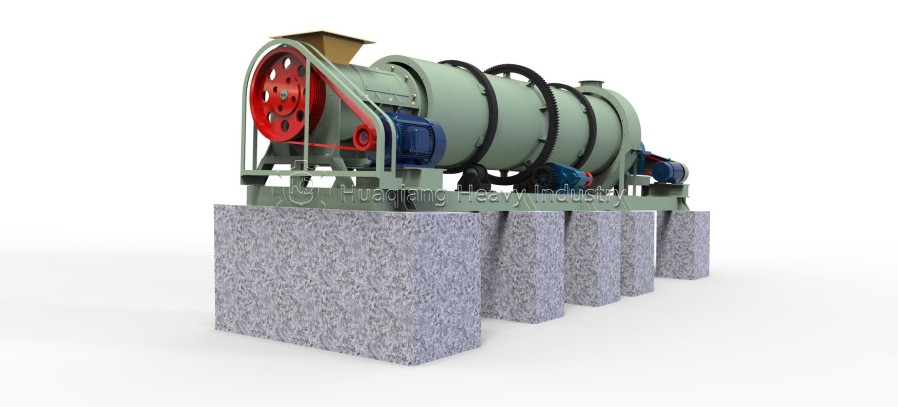
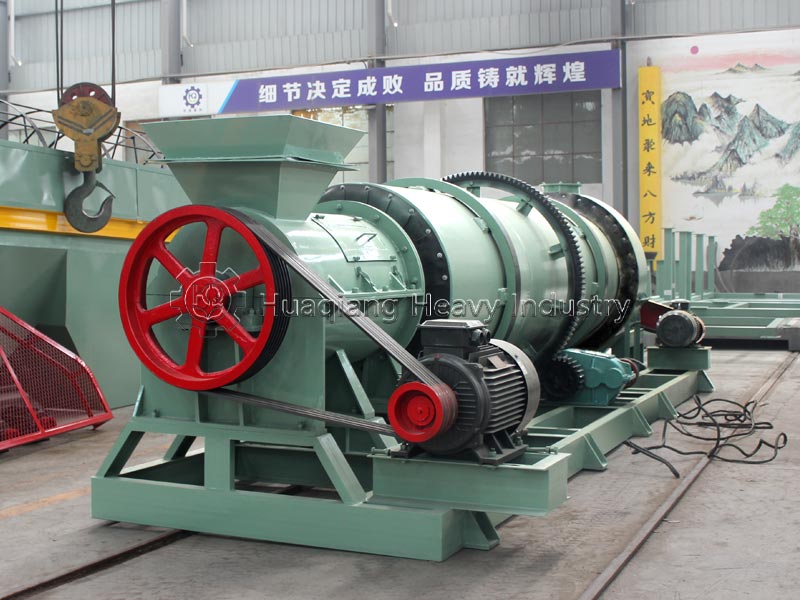
The “stirring-drum” composite granulator employs a wet continuous pusher granulation process. After entering the equipment, the material first passes through the primary stirring section, where the high-speed rotating stirring components forcefully shear and knead the material, breaking down large pieces and coarse fibers. These pellets then enter the secondary drum chamber, where they continuously roll and collide under centrifugal force and friction, ultimately forming smooth, round spherical particles.
The “extrusion-disc” combined granulator ensures the initial strength and density of the particles through extrusion, while the rolling friction of the disc stage optimizes the roundness and surface smoothness of the particles. Experimental data shows that the compressive strength of particles produced by this combined mode is 20%-30% higher than that produced by single extrusion granulation, and the particle qualification rate increases from 85% to over 95%.

Selection criteria and procurement recommendations
1. Capacity:Choose the appropriate model based on daily processing capacity. Small-scale processing requires a small model; medium-to-small-scale production requires a standard model; large-scale continuous production requires a medium model. It is recommended to reserve 10%-20% capacity margin.
2. Raw Materials:Select the appropriate technology based on the type of raw material. For high-moisture, high-fiber organic raw materials, prioritize a “stirring tooth-drum” composite type; for high requirements on particle strength and roundness, choose an “extrusion-disc” combination type.
3. Quality:Prioritize models that integrate granulation and shaping, are stable, energy-efficient, durable, and environmentally compliant. Pay close attention to granulation rate and particle roundness.
4. Service:Prioritize manufacturers with comprehensive after-sales service. Ensure on-site installation, operation training, and 48-hour emergency repair service. Verify the manufacturer’s production case studies.
Suitable candidates and purchasing recommendations
This equipment is primarily intended for production managers and technicians at fertilizer plants, chemical plants, and organic waste treatment companies. Material testing is recommended before purchase to confirm granulation performance. It is also important to assess whether the manufacturer provides installation guidance, personnel training, and after-sales service. The equipment can operate continuously for 24 hours and requires only 1-2 people to operate.
Production capacity data and investment reference data
Small models have a production capacity of 0.5-1.5 t/h, suitable for family farms and small cooperatives; standard models have a production capacity of 2-4 t/h, suitable for small and medium-sized organic fertilizer plants; medium-sized models have a production capacity of 5-8 t/h, suitable for large-scale production bases. Equipment investment is reduced by 40%-50% compared to the traditional split-type mode; the floor space is reduced by more than 50%; and the overall energy consumption is more than 30% lower than that of traditional combined equipment.
Model and parameters of the New Type Two In One Organic Fertilizer Granulator
| New Type Two In One Organic Fertilizer Granulator Machine | ||||
| Model | Capacity (t/h) | Output Granules Size (mm) | Motor Power (Kw) | Outside Dimension (mm) |
| YSL2-80/120 | 4-8 | 1-5 | 37+18.5+5.5 | 7500*2300*1950 |
| YSL2-100/150 | 6-10 | 1-5 | 55+18.5+11 | 7700*2550*2260 |
| YSL2-120/180 | 8-15 | 1-5 | 75+22+15 | 9600*3000*2750 |