
Ingredients, Individual Equipment, and the Complete Line: Three Levels of Responsibility for Blended Fertilizer Precision
When a blended fertilizer batch fails to meet its target formulation, many people immediately blame the mixer. However, whether the final product actually aligns with the recipe depends less on the mixer’s rotational speed and more on whether three distinct levels of the process are fulfilling their respective responsibilities: the multiple-silo single-weigh static batching system ensures batching precision; the NPK bulk blending machine ensures the mixture resists segregation (separation of particles); and the complete production line ensures the repeatability of the entire process. Confusing these three levels—the batching stage, the individual equipment category, and the overall production line—often leads to misattributing the cause of an error to the wrong piece of equipment.
The batching level addresses the question: “Can the proportions be locked in?” A multiple-silo, single-weigh static batching system discharges materials from various silos sequentially into a single, high-precision weigh hopper. Because weighing occurs while the materials are relatively stationary—unaffected by fluctuations in conveying speed or the impact of falling material—proportional errors can typically be kept within a very tight range. The true value here lies not in “weighing speed,” but in “batch-to-batch reproducibility.” That said, static weighing requires consistent material flow; otherwise, fluctuations in the feeding rhythm can still introduce deviations during the weighing process.
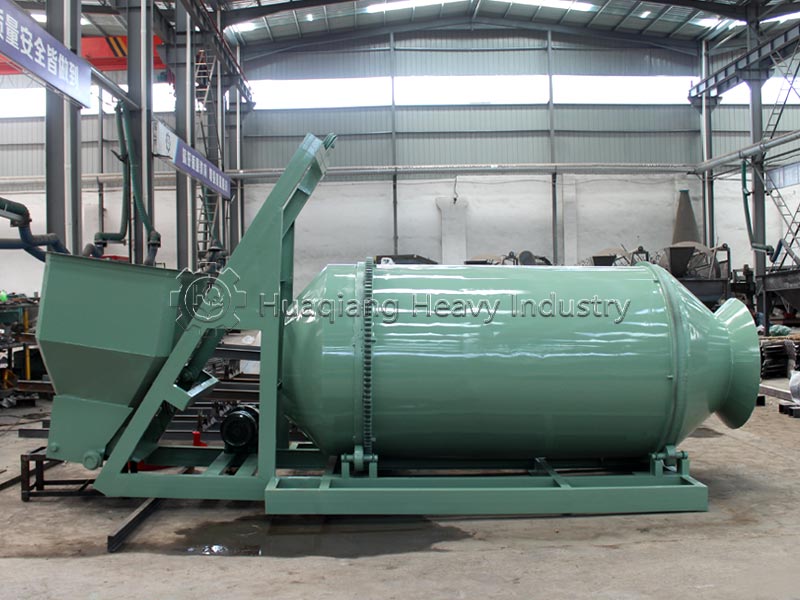
The equipment level addresses the question: “Will the ingredients separate again after mixing?” An NPK bulk blending machine handles finished granules—such as urea, diammonium phosphate (DAP), and potassium chloride (MOP). The core challenge is not merely blending the materials, but ensuring that granules of varying densities remain in their correct proportions despite the vibrations encountered during transport. Since there is a significant difference in bulk density between urea and potassium chloride, the mixing process typically employs low-speed convection. This allows the granules to swap positions without being crushed by high-shear forces. Furthermore, the average particle size of each component should be as uniform as possible; otherwise, no amount of extra mixing time can prevent lighter particles from rising and heavier ones from sinking. This type of equipment is specifically engineered for granular compatibility—it is not simply a generic horizontal mixer.
The production line level addresses the question: “Can this entire process be consistently reproduced?” An NPK blending fertilizer production line integrates raw material silos, automated batching, conveying systems, a primary mixer, finished-product silos, and quantitative packaging into a continuous process. Switching between different formulations is achieved by adjusting control parameters rather than through mechanical modifications. The scope of the system is clearly defined: it does not involve granulation or drying, nor does it correct inconsistencies in raw material quality; it simply ensures that the final, pre-qualified granular components meet the specified requirements. The production line as a whole does not take responsibility for the precision of the batching system or the prevention of segregation within the mixer; instead, it ensures that the transitions between each stage do not introduce new sources of variability.
The selection process should follow a three-tiered hierarchy: first, verify that the batching system can consistently maintain precise proportions; second, ensure that the blending equipment achieves an optimal balance between mixture uniformity, particle breakage rates, and the prevention of segregation; and finally, confirm that the overall line configuration is well-suited to the characteristics of your raw materials and the frequency with which you switch formulations. The precision of blended fertilizer is never determined by a single piece of equipment; rather, it is the result of each component in the system effectively fulfilling its specific, defined role.