
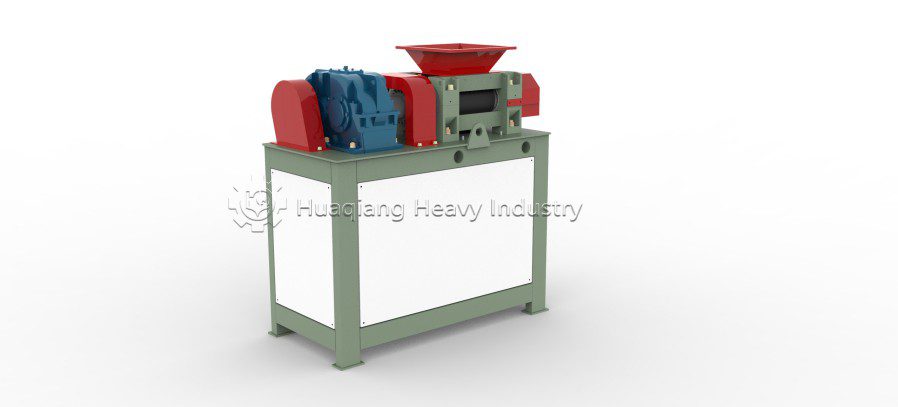
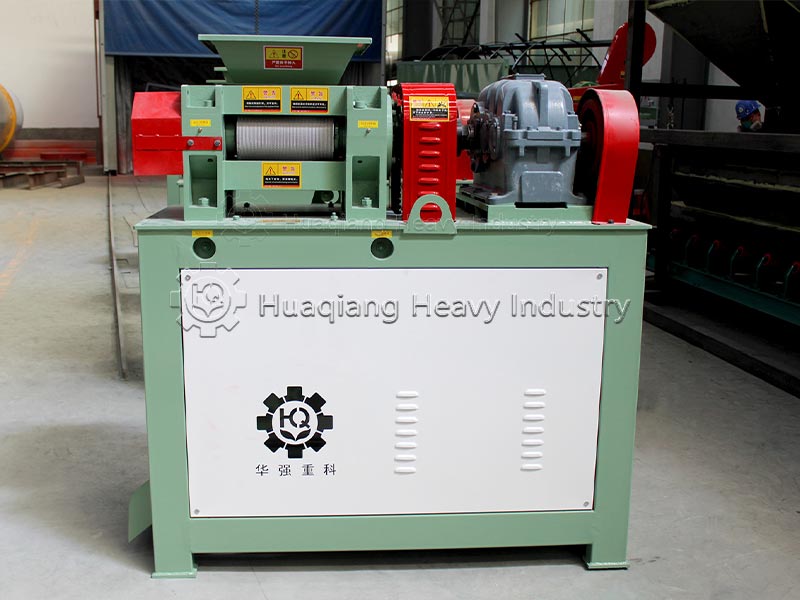
The double-roller extrusion granulator is a granulation device that utilizes dry roller-pressing technology. It primarily employs a pressurized feeding method to force material through the gap between two counter-rotating rollers, compressing it into flakes or chunks. During the roller-pressing process, the material’s actual density can increase by 1.5 to 3 times. The machine is easy to master and operate, and the extrusion pressure can be adjusted via hydraulic force.
The structure of the double-roll extrusion granulator comprises several coordinated systems:
Feeding and mixing section: Includes a metering feeder, as well as a bucket elevator and buffer hopper connected sequentially via the feeder.
Main extrusion unit: An electric motor drives a belt and pulley system, transmitting power through a gearbox to two output shafts; each shaft connects via a coupling to a molding roll, driving the two rolls to rotate in opposite directions.
Crushing system: Includes a primary crusher, a buffer hopper, a secondary crusher, etc.
Multi-stage screening system: Performs graded screening of the material.
Metering and packaging system: Includes metering and sealing/packaging equipment.
The granulation process of the roller extrusion granulator is based on the principle of “dry extrusion”. The core is to apply high pressure to the material through two relatively rotating rollers, so that the material is aggregated and granulated under the pressure. Its workflow can be divided into three key stages:
The first stage: raw material pretreatment
Add qualified raw materials to the mixer according to the ratio requirements and mix evenly
Control the moisture content of materials within a reasonable range (usually 5%-15%)
Incoming material particle size requirement ≦0.5mm
Second stage: extrusion molding
The material enters the pair of rollers after degassing and spiral pre-pressure.
Under the extreme squeezing force of the roller, the material is plastically deformed and compressed into a sheet.
Dry powder is directly granulated without subsequent drying process.
The third stage: crushing and screening
The flake materials undergo processes such as crushing, granulation, and screening to obtain granular products.
Qualified particles enter the next process, and unqualified particles return to be re-granulated.
The typical process flow for a double-roller extrusion granulator in a compound fertilizer production line is as follows:
1. Batching and Mixing Stage: Qualified raw materials are added to a high-efficiency mixer according to specified ratios and mixed thoroughly. The range of raw materials suitable for extrusion granulation is extensive; currently, over twenty types of materials have been successfully processed using this method. The extrusion granulation process allows for flexible and rapid product formula changes, enabling a single unit to produce more than thirty different formulations.
2. Feeding and Iron Removal Stage: The mixed material is conveyed to a disc feeder; during this transfer, ferrous impurities are removed to prevent damage to the roller shafts.
3. Extrusion Granulation Stage: Material from the disc feeder enters the extrusion granulator uniformly, where it is forced between two pressure rollers and compressed into thin sheets.
4. Crushing and Screening Stage: The sheets are broken into fragments by a coarse crusher located beneath the rollers and then screened; material retained on the screen undergoes further crushing and screening. Semi-finished products are conveyed to the final screening unit; undersized particles are returned directly to the disc feeder, while oversized particles are pulverized before being returned.
5. Packaging and Warehousing Stage: Qualified products are conveyed to an automatic packaging scale for weighing, packaging, and warehousing.
1. Materials are compacted into shape via mechanical pressure without the addition of any wetting agents, ensuring product purity.
2. The process flow is streamlined, offering low energy consumption and high output.
3. Dry powder is granulated directly, eliminating the need for subsequent drying and facilitating integration with or modification of existing production lines.
4. The resulting granules possess high strength, and the increase in bulk density is more significant than with other granulation methods.
5. The system offers great operational flexibility and a wide range of applications, with compaction pressure adjustable via hydraulic force.
| Fertilizer Granules Compaction Machine | ||||
| Model | DZJ-I 1.0 | DZJ-I 2.0 | DZJ-I 3.0 | DZJ-I 3.0 |
| Capacity (t/h) | 1-1.5 | 1.5-2.5 | 2-3 | 3-4 |
| Power (Kw) | 11 | 18.5 | 22 | 45 |
| Roller Dimension(mm) | ø150×220 | ø150×300 | ø186×300 | ø300×300 |
| Feed Material Size(mm) | <=0.5 | <=0.5 | <=0.5 | <=0.5 |
| Output Granules Size(mm) | ø2.5-ø10 | ø2.5-ø10 | ø2.5-ø10 | ø2.5-ø10 |
| Gearbox Model | ZLY-160 | ZLY-160 | ZLY-180 | ZLY-224 |
| Rotation Speed (r/min) | 60 | 60 | 60 | 60 |