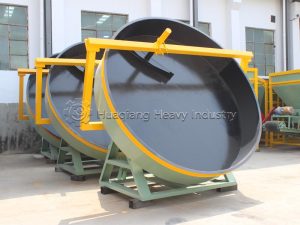
Is an organic fertilizer disk granulator machine suitable for large-scale production lines?
Organic fertilizer disk granulator machines are not well-suited for high-standard, large-scale, automated organic fertilizer production lines. They are more suitable for small to medium-sized ordinary organic fertilizer production capacities.
Firstly, in terms of capacity: Disc granulation is a type of agglomerating wet granulation, relying on water spraying and rolling to form the granules. It is greatly affected by raw materials, moisture content, and operational factors. With the same floor space, the output per machine is relatively low, less stable than double roller press granulators or drum granulators, making expansion difficult. Multiple parallel lines require significant space and manpower, making them unsuitable for large-scale production lines producing hundreds of tons per day.
Secondly, in terms of process stability: Disc granulation is highly dependent on material moisture content, fineness, proportions, rotation speed, and water spray volume, resulting in large fluctuations and poor controllability. Large-scale production requires continuous, stable, and minimally manned processes, while disc granulation relies on skilled workers to constantly adjust the discs, water, and materials. Its low automation level easily leads to problems such as uneven particle size, excessive return material, and low yield.
Thirdly, in terms of finished product quality… Disc granulation produces low-strength, brittle granules with high moisture content, resulting in high drying loads, high energy consumption, and significant loss of viable bacteria. This is unfavorable for large-scale, high-quality production of bio-organic fertilizers. Furthermore, the granules are prone to dusting during storage and loading, impacting sales and export standards.
Fourth, from an operating cost perspective: High return rates, large circulation volumes, high drying costs, and significant dust generation lead to a substantial increase in overall energy and labor costs during large-scale production, and greater environmental protection pressures.
Suitable scenarios: Small and medium-sized plants, general organic fertilizer production, limited budgets, and a preference for simple operation.
Large-scale preferred methods: Roller dry granulation and rotary drum composite granulation offer high capacity, high automation, low cost, stable quality, and good bacterial preservation, making them more suitable for long-term, large-scale production.