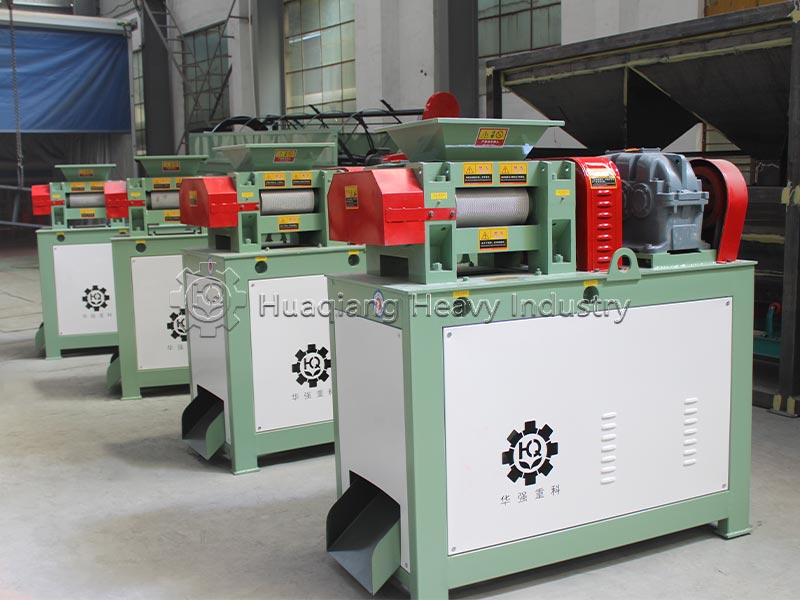
Causes of Severe Material Leakage and Spraying in Double Roller Press Granulators
Material leakage and spraying in double roller press granulators are mainly caused by problems in four aspects: sealing structure, equipment clearance, material condition, and operating conditions.
Firstly, sealing components fail. Long-term pressure wear on the baffles and dustproof gaskets on both sides of the machine body leads to gaps, deformation, and damage, failing to prevent material from being trapped. The roller end seals age and loosen, allowing powder to seep outwards from the gaps in the roller ends during extrusion, resulting in continuous leakage. Inadequate sealing at the joints of the protective cover allows particles and dust generated by high-pressure extrusion to easily splash outwards.
Secondly, improper adjustment of the pressure roller gap is a problem. If the distance between the two pressure rollers is too large, the material cannot be fully extruded and formed, allowing loose powder to fall directly from the sides and bottom of the roller body. Uneven gap deviation results in inconsistent force on both sides, causing chaotic material extrusion force and a large amount of powder to be thrown out at high speeds.
Furthermore, the material properties do not meet production requirements. If the raw material moisture content is too low and the powder content is too high, the extrusion molding properties are poor, making it impossible to compact into clumps, and fine powder easily scatters and splashes out. Excessive material feed rate and speed, exceeding the extrusion capacity of the fertilizer production machine, cause material to be squeezed out of the rollers before it can be formed, resulting in large-scale material leakage.
Finally, assembly and machine body issues, such as misaligned pressure rollers, loose machine body fixing bolts, and excessive machine body vibration during operation, exacerbate material ejection. Uneven roller surfaces due to wear lead to uneven material extrusion force, causing broken and flying particles. Damaged feed inlet guide structure causes material to land at an off-center point, scattering upon impact with the rollers.
Daily replacement of damaged seals, precise adjustment of the pressure roller gap, control of feed speed and material fineness and moisture content, and tightening of machine body connections can effectively solve the problems of material leakage and flying.