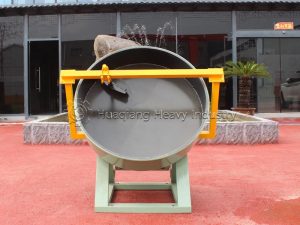
Production Process of Disc Granulation Production Line
Disc granulation production lines are the mainstream forming production lines for organic fertilizers and compound fertilizers. They rely on the rolling and binding of materials to form spheres, resulting in round and regular granules. Suitable for processing livestock manure, straw compost, and mineral powder raw materials, the entire process is streamlined and compact.
The entire production line process is divided into raw material pretreatment, mixing and humidification, disc granulation, drying and cooling, screening, and finished product packaging. The raw materials are first pulverized and refined in a crusher to remove hard lumps and impurities, and to standardize the fineness of the material. Then, they are fed into a mixer to add moisture and binders, improving the material’s agglomeration and adhesion, laying a good foundation for granulation.
The core equipment is the organic fertilizer disk granulator machine. By adjusting the disc inclination angle and rotation speed, combined with uniform spray water replenishment, the material continuously rolls and coats itself layer by layer, gradually forming uniformly sized spherical granules. The particle size can be flexibly adjusted to meet the requirements of different product specifications.
The formed wet granules are fed into a drum dryer for low-temperature dehydration, with strict temperature control to protect the organic matter. After drying, they are cooled by air cooling to prevent the granules from softening and sticking together. The material then enters a vibrating screen for grading, removing fine powder and deformed particles. Qualified particles are conveyed and packaged, while undersized powder is returned for regranulation, reducing raw material loss.
The system includes belt conveyors, dust removal, and electrical control systems, ensuring fully automated operation with minimal dust generation. This production line is highly versatile, capable of producing organic fertilizer, humic acid fertilizer, and compound granular fertilizer. The equipment is simple to operate and easy to debug, producing high-quality finished products with high market acceptance. Daily maintenance only requires periodic cleaning of the trays, inspection of the spray and transmission components, and control of material moisture content and fineness to ensure stable production of qualified granular fertilizer.