
Two Invisible “Rulers”: Blending Lines Measure by Numbers, Disc Granulators Measure by Conditions
In the fertilizer industry, two adages are frequently cited: “Blended fertilizers must be formulated precisely,” and “Organic fertilizers must be granulated into uniform, round particles.” While these may sound like entirely distinct technical approaches, a deeper look reveals that each relies on its own “invisible ruler.” An NPK blending fertilizer production line uses a numerical ruler to gauge the formulation, while a bio-disc organic fertilizer granulator uses a “conditional” ruler to assess the state of the granules. Because these two rulers operate on fundamentally different logic, conflating them is a recipe for failure.
The numerical ruler of a blending line is calibrated by “weight.” The core function of an NPK blending machine (or bulk blending system) is not to alter the raw materials themselves, but to precisely assemble pre-existing, high-quality granules—such as urea, diammonium phosphate (DAP), and potassium chloride—according to a specific recipe. This ruler measures the readings from a multi-hopper static weighing system: each ingredient is weighed individually, accumulated sequentially, and only released once the full, accurate batch has been tallied. The advantage here is reproducibility; a formulation weighed out today can be replicated tomorrow with precision down to the decimal point. However, this numerical ruler has a blind spot: it cannot determine whether the particle sizes of the various ingredients are compatible. If the urea granules are coarse while the potash granules are fine, even the most thorough mixing will not prevent them from re-segregating due to vibration during transport. Since the numerical ruler can verify the formulation but not the risk of segregation, a screening stage must be implemented upstream to serve as a necessary safeguard.
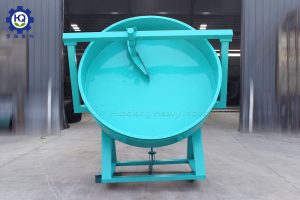
In contrast, the “conditional” ruler used by a disc granulator is calibrated by “state.” A bio-disc organic fertilizer granulator processes fermented, decomposed organic matter—materials that vary significantly in terms of moisture content, stickiness, and fiber composition. The pelletizing process does not rely on weighing; instead, the material is tumbled repeatedly within a tilted rotating disc—driven by gravity, centrifugal force, and friction—where fine powder gradually accumulates in layers around atomized water droplets, growing into larger pellets. This “measuring tool” assesses the material’s current state: if it is too dry, the particles remain loose and fragile; if it is too wet, they clump together. Only when the moisture content falls within an optimal range can the disc produce well-rounded, uniform pellets. Operators must rely on their experience to make real-time, nuanced adjustments to the disc’s tilt angle and the rate of water spraying—a judgment call that cannot be reduced to a simple numerical reading like that of a weighing scale. While this method effectively gauges the material’s physical state, it cannot determine precise formulation ratios; that task must be handled by the upstream proportioning system.
Interestingly, both types of “measuring tools” coexist on a complete production line for organic-inorganic compound fertilizers. The blending line uses a “numerical scale” to ensure the inorganic nutrients meet specific quantitative requirements, while the disc-granulation line uses a “conditional scale”—based on physical state—to grow organic materials into pellets. Finally, mixing equipment combines these two types of granules. In this setup, each tool must stick to its own domain: the proportioning stage focuses on numerical readings, while the granulation stage focuses on physical state; neither should overstep its bounds to make decisions for the other. Attempting to use a numerical scale to dictate the roundness of pellets, or using a conditional scale to verify the precision of a nutrient blend, would simply be a misuse of these tools.
The reliability of fertilizer production does not depend on which tool is more precise, but rather on whether each tool is applied to the specific aspect it is designed to measure. By using the numerical scale for formulations and the conditional scale for physical states—and ensuring both are applied correctly—the final product is guaranteed to meet the required standards.