
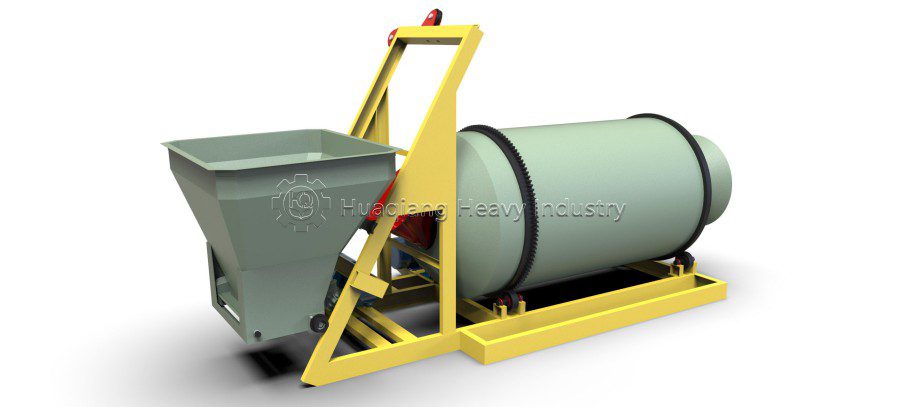
BB Fertilizer Mixer

Our Services

Have a
project in
mind?

BB Fertilizer Mixer

The BB fertilizer mixer (also known as a blended fertilizer mixer or a horizontal/twin-shaft BB fertilizer mixer) is a core piece of equipment in soil-testing-based formula fertilization and bulk blended fertilizer production lines. It enables the precise physical blending—in specific proportions—of granular nitrogen, phosphorus, and potassium fertilizers, as well as additives containing secondary and trace elements. It addresses critical processing bottlenecks such as nutrient imbalances caused by uneven manual mixing, increased powder formation (which impairs spreading performance) resulting from the crushing of granules by high-speed impellers, cross-contamination between batches, and low production capacity due to lengthy mixing times.
The BB fertilizer mixer employs a unique, gentle convective blending principle. Through the specific configuration of spiral ribbons or paddle angles, materials are induced to circulate simultaneously in both axial and radial directions without being subjected to strong impact forces. This design ensures minimal granule breakage (with breakage rates typically controlled at ≤1%–3%) and achieves a coefficient of variation (CV) for mixture uniformity of ≤5% (with high-standard requirements often specifying ≤3%), thereby meeting strict national standards regarding nutrient uniformity in BB fertilizers.

Structural composition of the equipment

The BB fertilizer mixer features a design specifically intended to preserve granule integrity:
(I) Frame and Drive System: Constructed from welded high-quality carbon steel plate and channel steel. The motor drives the system via a pulley, V-belt, and speed reducer.
(II) Gentle Mixing Drum: Fabricated from high-quality carbon steel plate using a specialized process, the drum features internal spiral mixing blades.
(III) Damage-Minimizing Mixing System: Mixing paddles or ribbons are made of wear-resistant alloy and polished to minimize material adhesion. The unique angles of the spiral ribbons or paddles induce simultaneous axial and radial circulation of the material without exerting strong impact forces.
(IV) Cross-Contamination Prevention Design: The unit can be equipped with a high-pressure air purge system or manual clean-out ports to prevent cross-contamination between different formulations.
(V) Skip Hoist Feeding Section: The guide rails are constructed from high-quality channel steel.

Application scope of the equipment

BB fertilizer mixers are primarily designed for the gentle, damage-free dry blending of granular fertilizer raw materials—such as urea, potassium chloride, monoammonium phosphate (MAP), diammonium phosphate (DAP), and potassium sulfate—which typically come in spherical or oblate granular forms. They are widely suitable for BB fertilizer production facilities with annual capacities ranging from 3,000 to 100,000 tons, large-scale agricultural supply distribution and blending centers, and soil-testing and formula-fertilization service stations.
In the context of soil-testing and formula-fertilization services, these mixers enable small-batch, customized blending by allowing for flexible adjustments to N-P-K ratios and the inclusion of secondary nutrients and trace elements (such as boron, zinc, and molybdenum) based on soil test results. Certain models are also capable of the gentle blending of non-sticky, free-flowing granular materials, such as table salt, crystalline chemical products, and coated seeds.

Types of usable raw materials

The BB fertilizer mixer is suitable for dry, free-flowing granular materials (typically with a moisture content of less than 2% and no significant caking or stickiness). Raw materials include urea, potassium chloride, monoammonium phosphate (MAP), diammonium phosphate (DAP), potassium sulfate, and others. The raw material granules should have similar specific gravities and particle sizes to prevent segregation during transport.

The working principle of the equipment

The working principle of the BB fertilizer mixer is based on gentle convective blending. Materials undergo mild tumbling and convective mixing within a specially designed mixing chamber for a short duration (typically 60–180 seconds). The optimized angles of the inner and outer spirals induce simultaneous axial and radial circulation of the materials without exerting strong impact forces. The equipment operates with reversible rotation. Upon completion of mixing, a pneumatic or electric discharge gate opens rapidly to transfer the finished product into a buffer hopper or an automatic quantitative packaging machine, ensuring short batch intervals and minimal residual material.

Equipment maintenance methods

(I) Routine Cleaning: Thoroughly clear out accumulated material from the machine at the end of each shift. Promptly repair or replace blades with wear exceeding 5mm. Conduct regular inspections of mechanical components (1–2 times per month).
(II) Lubrication and Maintenance: Periodically replace grease in all bearings. Regularly apply high-temperature lubricant to the lifting guide rails.
(III) Corrosion Protection: Components in contact with material are typically constructed from carbon steel lined with 304 stainless steel or made entirely of stainless steel to resist corrosion from fertilizers. Apply a fresh coat of protective paint to the machine frame after the production season ends.

Equipment operating instructions

(I) Pre-start checks: Inspect the mixer body for secure mounting. Check the mixing paddles to ensure there is no deformation or wear. Inspect the drive system. Screen raw materials to remove impurities and ensure consistent particle size across all materials.
(II) Feeding procedure: Follow the principle of “light before heavy, fine before coarse, and dry before wet.” First, load fine-grained, lightweight materials; next, load medium-grained materials of medium specific gravity; finally, load coarse-grained, heavy materials.
(III) Mixing and discharging: Control the mixing time (60–180 seconds). Upon completion of mixing, rapidly open the pneumatic or electric discharge gate to empty the finished product into the buffer bin.