
Three Critical Choices in Fertilizer Processing: From Raw Material Form to Search Visibility
There is an easily overlooked engineering principle in fertilizer production: the suitability of equipment selection is often determined the moment raw materials enter the plant. The NPK blending machine, NPK Blending Fertilizer Production Line, and organic fertilizer disc granulator machine represent three distinct process pathways tailored to different initial raw material states; understanding the boundaries between them is more practically significant than merely comparing individual machine specifications.
The applicability of the NPK bulk blending machine is clearly defined: raw materials must be qualified, finished granules. Urea, diammonium phosphate (DAP), and potassium chloride arrive from upstream plants as intact granules, so the blending line’s task is simply accurate weighing and thorough mixing. The batching stage employs a multi-bin static weighing structure where each raw material is weighed individually; combined with variable frequency drives (VFDs) that control fast and slow feeding speeds, metering accuracy can be maintained within ±0.5%. However, the blending process faces a strict constraint: the difference in average particle size between components should ideally be kept within 1 millimeter. Otherwise, vibration during transport can cause secondary segregation, potentially resulting in a significant discrepancy between the actual nutrient content in the bag delivered to the farmer and the intended formula. The key to solving this issue lies not in the mixer itself, but in the screening stage prior to the raw materials entering the plant.
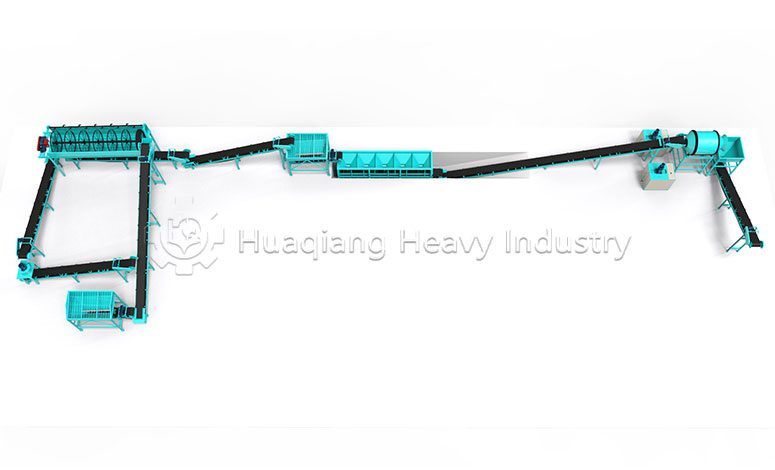
The complete workflow of an NPK Blending Fertilizer Production Line encompasses quantitative batching, automatic conveying, uniform mixing, screening, and finished product packaging, making it suitable for medium-sized fertilizer plants and regional blending stations. The core advantages of this line are “zero high-temperature processing, low energy consumption, and a small footprint.” Compared to granulation-based lines, it eliminates the granulation, drying, and cooling stages, significantly reducing both facility investment and operating costs. Yet, its operational limits are equally clear: raw materials must be granular and possess good flowability. If the raw materials are primarily powdery, or if the formula contains large amounts of ingredients prone to deliquescence upon contact with moisture (such as urea), the blending route is unsuitable, and one must instead opt for extrusion granulation.
The organic fertilizer disc granulator machine deals with a completely different world of materials. Fermented and decomposed organic materials typically have a moisture content of 25% to 35%; characterized by high viscosity and strong fibrous qualities, they are unsuitable for either blending or dry extrusion processes. Disc granulators utilize a tilted, rotating disc to cause materials to tumble and agglomerate under the combined forces of gravity, centrifugal force, and friction; the disc’s tilt angle is adjustable between 35° and 55°, enabling a granulation rate exceeding 93%. Operators must make real-time, fine adjustments to the tilt angle and water spray volume based on the material’s tumbling behavior; this experience-based dynamic adjustment is an indispensable part of the disc granulation process. One easily overlooked detail is the management of recycled material—reintroducing 30% to 50% of screened fine powder as “seed material” effectively promotes uniform granule growth, with the recycle ratio typically maintained between 10% and 20%.
From an engineering selection perspective, these three pathways correspond to three distinct raw material requirements: blending lines require qualified granules, extrusion lines require dry powder, and disc lines require decomposed material with moderate moisture content. The first step in equipment selection is never comparing price quotes, but rather verifying the initial state of the raw material—as this determines which process route is physically feasible.