
The “Moisture Balance” and “Thermal Balance” of Granules: An Overlooked Process Divide
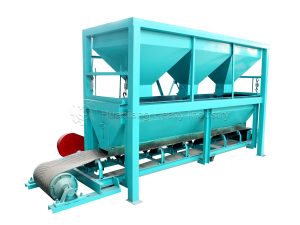
In fertilizer production, there is a dividing line more fundamental than N-P-K content; it distinguishes between two vastly different material-handling logics: whether the material can tolerate water and whether it can withstand heat. The double-roller press granulator represents the “avoid water and heat” approach, while the bio-organic fertilizer production line represents the “temperature control for viability” approach; meanwhile, the multiple-silo single-weigh static batching system and the BB fertilizer mixing process constitute the shared prerequisites for both routes.
The process logic of the double-roller press granulator can be summarized in one sentence: using pressure instead of moisture. Two high-strength rollers rotating toward each other instantly compress powdered material into a dense sheet at ambient temperature. The bonding force between granules stems from natural molecular-level attractions—such as van der Waals forces, adsorption, and crystal bridging—without the addition of a single drop of water or any rise in temperature. The roller press machine imposes extremely strict requirements on the moisture content of the feed material, usually necessitating levels below 5%. If moisture content exceeds this limit, the wet material slips between the rollers, resulting in uneven sheet thickness; conversely, if moisture content is too low, the material becomes too fluid to form a continuous layer, causing the granulation rate to plummet. The truly irreplaceable value of this dry extrusion technology lies in its ability to avoid heat; high-urea formulations would melt and turn into a paste when exposed to heat, and materials containing low-melting-point components would clump together during the drying stage. In principle, dry extrusion bypasses the two “troublemakers”: moisture and heat.
In contrast, the bio-organic fertilizer production line faces the exact opposite set of constraints: it requires moisture but must strictly avoid high temperatures. The core value of bio-organic fertilizer lies in its content of live functional bacteria; common strains, such as Bacillus subtilis, are extremely sensitive to temperature. In industry practice, the drying of bio-organic fertilizer requires a staged, variable-temperature strategy: the drying system’s ambient temperature is kept below 120°C while the material temperature remains at or below 65°C. Negative pressure facilitates the rapid evaporation of surface moisture, and a secondary drying phase follows once moisture from the deeper layers has migrated to the surface via capillary action. This two-stage variable-temperature process allows the survival rate of beneficial live microorganisms to exceed 90%. In contrast, conventional organic fertilizers are typically dried at temperatures around 300°C; applying these parameters to bio-organic fertilizer would result in the near-total loss of functional microbial populations.
From moisture content ranges to temperature limits, and from ingredient precision to mixing shear forces, every step of the fertilizer processing workflow addresses the same fundamental question: “What is this material sensitive to?” Materials sensitive to moisture undergo extrusion; those sensitive to heat undergo temperature-controlled drying; and for materials sensitive to both, the solution lies in highly precise ingredient proportioning and restrained mixing. The quality of the process design is precisely demonstrated by the ability to identify and accommodate these specific material sensitivities.