
“Cold Assembly” vs. “Thermal Cultivation” in Fertilizer Production: The Underlying Logic of Two Production Lines
In the fertilizer processing industry, there is a dividing line more fundamental than NPK content—one that distinguishes between two completely different production methods. One operates at ambient temperature, leaving the chemical identity of the materials unchanged throughout the process; the other relies on microbial metabolic activity to gradually “cultivate” waste into fertilizer. The NPK Blending Fertilizer Production Line and the bio-disk organic fertilizer machine stand on opposite sides of this divide.
The NPK Blending Fertilizer Production Line represents the logic of “cold assembly.” The entire line operates at ambient temperature without the addition of heat, water, or chemical binders. Base fertilizers—such as urea, diammonium phosphate (DAP), and potassium chloride—arrive from upstream plants as finished granules; the production line simply “assembles” them according to a specific formula. This assembly process hinges on two technical keys: first, batching precision, where static weighing systems must minimize component variance within each batch; and second, mixing uniformity, achieved by the NPK bulk blending machine through low-speed convection that repeatedly shifts the positions of granules with varying densities while preserving their original shape. A detail often overlooked is that the quality of blended fertilizer depends not only on accurate proportions but also on matching granule sizes; if urea granules are coarse while potassium fertilizer granules are fine, vibration during transport can cause automatic segregation, resulting in inconsistent nutrient content across bags by the time they reach farmers. Consequently, this production line imposes strict requirements on raw material particle size, typically mandating that the difference in average particle size between components does not exceed 1 millimeter.
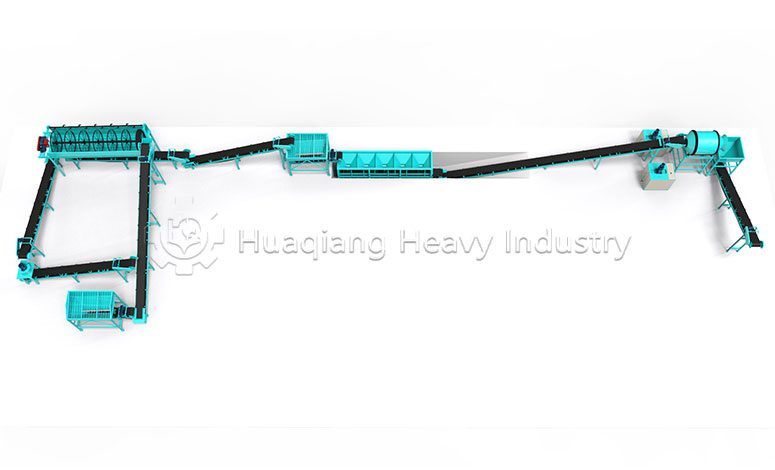
In contrast, the bio-disk organic fertilizer machine follows the diametrically opposite path of “thermal cultivation.” Its raw materials are not industrial finished products but organic wastes such as livestock manure, crop stalks, and distillery grains. These materials cannot be granulated directly; they must first undergo high-temperature aerobic fermentation. During this process, the pile temperature is maintained between 55°C and 65°C for several days, allowing aerobic microorganisms to proliferate rapidly, decompose organic matter into humic acid, and simultaneously eliminate insect eggs, pathogens, and weed seeds. Even after fermentation and maturation, the material retains high moisture content and a fibrous nature, making it difficult to process using standard extrusion or pin-type granulation methods. The solution offered by the disc granulator involves a tilted, rotating disc that causes the material to tumble along a parabolic trajectory under the combined influence of gravity, centrifugal force, and friction. As atomized water is sprayed to adjust moisture levels, fine particles accumulate layer by layer—much like a rolling snowball—and gradually grow in size. The disc’s tilt angle is typically adjustable between 35 and 55 degrees, and the rotation speed is inversely proportional to the disc diameter; operators must make real-time fine-tuning adjustments based on fluctuations in the material’s moisture and fiber content.
The differences between these two production lines extend far beyond the equipment itself. The core competitive advantage of the blended fertilizer line lies in its “responsiveness to formulation changes”—an order received in the morning can be switched to a new formulation for production by the afternoon, making it well-suited for a fragmented, customization-driven agricultural inputs market. In contrast, the initial stage of the organic fertilizer line involves a lengthy biological transformation process measured in weeks; its value lies not in speed, but in “transformation”—converting what others view as waste into the humus that soil requires.