
【FAQ】Why does the “initial form” of raw materials determine the production line configuration?
Discussions on fertilizer production line design often begin with equipment selection. However, the true determinant of the production line’s layout is the initial form of the raw materials upon arrival: are they uniform granules, moist powders, or microbe-laden fermented matter? Different initial forms necessitate completely different processing paths and dictate the configuration logic for the entire line.
Granule-to-Granule: The starting point for NPK blending lines. Base fertilizers such as urea, diammonium phosphate (DAP), and potassium chloride (MOP) leave the factory as industrial granules with uniform size and sufficient strength. They do not require re-granulation; they simply need to be mixed precisely according to a formula. This is the fundamental logic of an NPK blending line: the raw materials are already in their finished form, so the line’s task is merely “proportioning” and “mixing.” The NPK blender utilizes a twin-shaft paddle structure where the shafts rotate in opposite directions, blending various granular materials thoroughly within 2 to 5 minutes—achieving a coefficient of variation (CV) of ≤5%—without damaging the granule structure. The core of the NPK blending line lies in batching precision and segregation-prevention design: a multi-bin single-scale static batching system keeps errors within ±0.2%, raw material particle sizes must be matched (with a difference of ≤0.5mm), and drop heights during conveying are minimized.
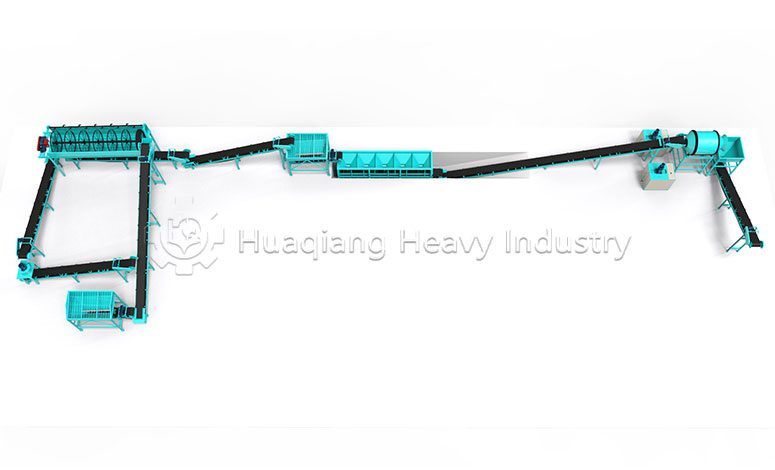
Powder-to-Powder: The starting point for granulation lines. If the raw materials are powdery—whether mineral fines, industrial by-products, or pulverized organic matter—the production line’s task shifts to “turning powder into granules.” This requires equipment such as a double-roller extrusion granulator. The choice of granulation method depends on the material’s fineness and moisture content: dry powders with 8%–15% moisture are suitable for roller extrusion, while moist materials with 25%–35% moisture are suited for disc granulation.
Live Microbes vs. Temperature: Special constraints for bio-organic fertilizer lines. The raw materials for bio-organic fertilizer consist of fermented, decomposed organic matter that inherently contains large quantities of functional microbes. The initial form of these materials is moist, fibrous, and biologically active. The core constraint of the production line is no longer production capacity or processing intensity, but temperature. The disc granulator for bio-organic fertilizer utilizes a physical forming process at ambient temperatures; materials naturally roll into spheres on an inclined disc, maintaining a stable temperature range of 30–55°C throughout. If raw materials are overheated before entering the granulator (e.g., due to insufficient cooling after high-temperature fermentation) or are subjected to a high-temperature drying process after granulation, the functional bacteria will suffer massive die-off.
The initial state of the raw materials dictates both the “first step” and the “final constraint” of the production line: granular materials are suited for blending, powdery materials for granulation, and microbe-laden materials require strict temperature control. Before selecting a production line, one must clearly understand the nature of the raw materials—this factor is more critical to determining the soundness of the investment than comparing equipment prices.