
【FAQ】What bottleneck problems do dry granulation, bio-organic fertilizer, and static batching each solve in production?
There are three easily underestimated but often bottleneck-prone technical nodes in fertilizer production lines. Understanding the logic behind them is more important than simply comparing equipment prices.
I. Double Roller Press Granulator: Why can it be “dry-free”?
The core advantage of the Double Roller Press Granulator lies in its “dry, room-temperature process.” Material is directly compressed into dense flakes or blocks under external pressure by a pair of high-strength, counter-rotating extrusion rollers. No water, heating, or binders are required throughout the process.
The value of this process lies in eliminating the need for a complete set of thermal equipment such as hot air furnaces, dryers, and coolers. This reduces the energy consumption of the entire production line and shortens the investment payback period. The essence of roller extrusion granulation technology is to replace heat with mechanical force, eliminating the “drying” process from the production line.
Its applicable scenarios are also clear: powdery materials need to be transformed into high-strength granules, and the materials themselves should not be exposed to high temperatures or moisture. However, roller extrusion granulation has strict requirements on the feed particle size—usually ≤0.5mm—and the material moisture content must be controlled at a low level.
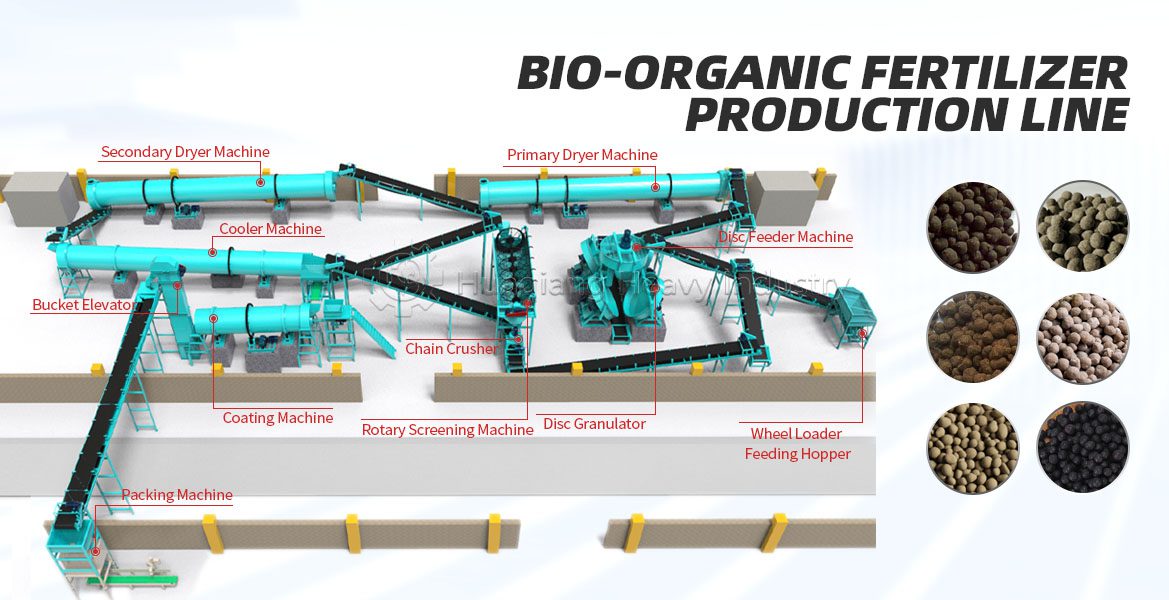
II. Bio-organic Fertilizer Production Line: High Temperatures are a “Killer” for Microorganisms
The fundamental difference between a bio-organic fertilizer production line and a conventional organic fertilizer production line lies in the “live bacteria.” Functional bacteria (such as Bacillus subtilis) are extremely sensitive to temperature—above 60℃, their survival rate begins to plummet.
If the production line design adopts a high-temperature drying process, all the previous fermentation and granulation efforts will be wasted. The bio-organic fertilizer granulation process must choose a low-temperature molding method. The production line’s operational logic must adhere to the principle of “low-temperature granulation, room-temperature molding”—from crushing, batching, mixing to granulation and drying, every piece of equipment serves to “preserve the activity of the microbial strain.”
III. Static Batching System: How much difference does a 0.2% accuracy error make for an annual output of 50,000 tons?
The multi-silos single-weigh static batching system is a key piece of equipment for solving the problem of batching accuracy. It is suitable for batching 3-8 kinds of materials. Each raw material silo sequentially feeds material into the same weighing hopper, weighs it one by one, and then the batches are collected and transported. Each batch of raw material is weighed in a completely static state, unaffected by fluctuations in conveyor belt speed, and the batching error can be controlled within ±0.2%.