
Granulation or Blending? Practical Selection Logic for Three Technical Routes
In fertilizer production equipment selection decisions, the most common pitfall for companies is not “not knowing what equipment is available,” but rather “not knowing which route to choose.” Disc granulators, roller press granulators, and BB fertilizer blending production lines represent three distinct technical routes: wet pelletizing, dry press, and physical blending, respectively. There is no absolute superiority or inferiority among them; the choice depends on the suitability of raw material characteristics, production capacity targets, and cost structure.
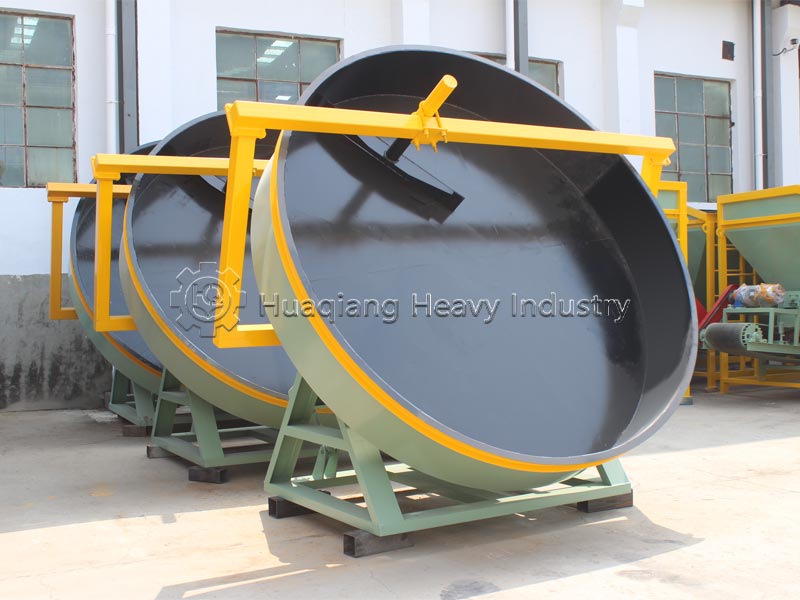
Disc granulators (also known as organic fertilizer disc granulators or bio-organic fertilizer disc granulators) employ the classic wet rolling molding principle. A disc tilted at 35° to 55° rotates at a constant speed. Material with a moisture content of 25% to 40% is fed into the disc and, under the combined action of centrifugal force, friction, and gravity, continuously tumbles, adheres, and grows, eventually naturally overflowing from the edge of the disc as spherical granules. Disc granulators achieve a granulation rate of over 93%, producing smooth, round granules with high marketability, making them particularly suitable for organic and bio-organic fertilizer production where high aesthetic standards are required. This equipment features a simple structure, intuitive operation, and low investment threshold; a single unit can operate independently, making it a mature choice for small to medium-scale production lines with an annual output of less than 100,000 tons. Disc granulation production lines are typically equipped with a twin-shaft mixer for organic fertilizer as a pre-processing unit—powdered materials are first uniformly mixed with atomized water in the twin-shaft mixer to form granules, which are then fed into the pelletizing discs for granulation.
Unlike the “wet rolling” method of disc granulation, roller press granulators (also known as fertilizer roller press granulators) utilize a dry press process. The core working components of this equipment are a pair of high-strength pressure rollers rotating in opposite directions. Dry powder with a moisture content of 8% to 15% is fed into the gap between the two rollers by a forced feeder and pressed into thin sheets under high pressure of 20 to 30 MPa. After crushing and screening, the finished granules are obtained. The biggest advantage of the double-roller press granulator is that it eliminates the need for drying—the molding process does not add water or produce wet material, saving the drying and cooling processes required by traditional wet granulation, reducing energy consumption per ton of fertilizer by more than 60%. The produced granules are irregularly cylindrical or flattened round, with a compressive strength of 20 to 30 Newtons, and are not easily pulverized during storage and transportation. The double-roller press granulation production line consists of equipment such as a crusher, feeder, mixer, double-roller press granulator, screening machine, and packaging machine. The entire line has a compact layout, moderate investment, and no waste emissions, making it suitable for large-scale production of over 100,000 tons per year. The new two-in-one organic fertilizer granulator represents the integration trend in this field—this equipment condenses the crushing and granulation processes into a single machine. After fermentation, the semi-wet material enters the feed inlet and is first crushed by a high-speed rotating crushing rotor, then directly enters the granulation chamber to complete the molding, achieving continuous production from raw materials to finished granules.
The BB fertilizer blending production line, however, represents a completely different production logic—no granulation, only blending. BB fertilizer (blended fertilizer) uses pre-granulated single-element fertilizers (such as large-particle urea, monoammonium phosphate, potassium sulfate, etc.) as raw materials, and the production process is essentially a purely physical mixing process. The entire BB fertilizer blending production line consists of a raw material storage system, a dynamic batching and metering system, an NPK mixer, and an automatic packaging system. The NPK mixer uses a twin-shaft paddle or zero-gravity mixing structure, allowing materials to be uniformly mixed within 30 to 90 seconds. This equipment is specifically optimized to address the stratification and segregation issues of particles of different densities and sizes during the mixing process, ensuring that the nutrient content of each bag of product matches the formula design requirements. The entire line uses centralized PLC control, allowing for flexible and convenient formula switching. A single production line can produce dozens of different formulas on the same day. Compared to traditional compound fertilizer production lines, BB fertilizer production lines require less investment, consume less energy, and have a faster start-up time.
Choosing the right technology depends on the specific materials used. High-moisture, high-viscosity organic materials, such as chicken manure and fermented straw, are suitable for wet processing methods like disc granulation; low-moisture, dry materials, such as compound fertilizers and mineral powders, are suitable for dry processing methods like roller press; and for scenarios where finished granular raw materials are directly purchased for formulation blending, a BB fertilizer blending production line is the optimal solution. Each of these three types of equipment has its strengths; the key is to accurately match the specific needs—choosing the right one is beneficial to all.