
Selecting Organic Fertilizer Granulation Processes: The Engineering Logic Behind Disc Agglomeration, Double-Roller Extrusion, and Integrated “Two-in-One” Systems
When selecting organic fertilizer granulation equipment, a crucial engineering fact is often overlooked: even when processing the same composted livestock manure, different process routes yield granules that differ vastly in density, strength, and the subsequent drying load. Disc granulators, double-roller press granulators, and the new “two-in-one” organic fertilizer granulators represent three distinct process routes; understanding the specific physical challenges each addresses is more practically significant than merely comparing individual machine specifications.
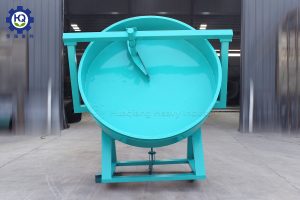
Disc granulation follows a wet agglomeration route. Its core component is a rotating disc mounted at an incline—adjustable between 35° and 55°—spinning at 10 to 20 revolutions per minute. Driven by the combined forces of friction, centrifugal force, and gravity, the material rises along the inner wall before rolling back down, creating a continuous tumbling cycle. Following precise moisture addition via an atomizing spray system, fine powder particles agglomerate layer-by-layer around “nuclei,” automatically spilling over the disc edge once they reach a diameter of 2 to 5 mm. While disc granulation achieves a pelletization rate exceeding 90%—producing smooth, spherical granules—the resulting product typically retains 8% to 12% moisture, necessitating downstream drying and cooling equipment to reduce moisture content below 3% for safe storage. For a facility with an annual capacity of 50,000 tons, the total investment for a complete disc granulation line is approximately 2 to 3 million RMB, with coal costs for the drying stage alone ranging from 50 to 70 RMB per ton of finished product.
Double-roller extrusion granulation employs a completely opposite approach: the dry method. Two high-strength rollers rotating toward each other compress dry powder material (with a moisture content of no more than 5%) directly into dense sheets at ambient temperature; these sheets are subsequently crushed and screened to produce granules. The entire process requires neither added water nor a rise in temperature, thereby eliminating the need for the drying and cooling systems essential to wet granulation methods. For a production line of equivalent scale, the total investment for a roller press granulation line ranges from approximately 1.5 to 2.2 million RMB—15% to 25% lower than that of a disc granulation line—with a comprehensive power consumption of about 25 to 35 kWh per ton. However, this method imposes strict limits on the moisture content of the feed material. Furthermore, the patterned roller surfaces are wear parts with a lifespan of roughly 3,000 to 5,000 hours; replacing a pair of rollers costs between 30,000 and 80,000 RMB, translating to a spare-part cost of approximately 8 to 15 RMB per ton of product.
The design philosophy of the new “two-in-one” organic fertilizer granulator falls somewhere between these two approaches. It integrates mixing and granulation within a single drum: high-speed stirring teeth at the front end shear and break up the material; centrifugal force and mechanical extrusion in the middle section facilitate agglomeration; and a built-in polishing assembly at the rear rounds the granules immediately after formation. This equipment can directly process fermented materials with moisture content ranging from 20% to 40% without requiring pre-drying or fine pulverization, offering significantly better tolerance for raw material fluctuations than separate-unit systems. Taking the YSL2-80/120 model as an example, it boasts an hourly output of 3 to 5 tons and an installed power of 58.2 kW. This integrated design minimizes material transfer between process stages, reduces heat loss and granule breakage, and is ideally suited for small-to-medium-sized organic fertilizer plants facing space constraints and significant fluctuations in raw material moisture content.