
From Powder to Spherical Granules: How Does a Disc Granulator Produce Bio-organic Fertilizer Without Heat?
The fundamental difference between bio-organic fertilizer and ordinary organic fertilizer lies in the addition of functional microbial strains. These live bacteria are the source of the fertilizer’s ability to promote growth, resist disease, and solubilize phosphorus and potassium; however, they share a common “weakness”: heat sensitivity. The vast majority of beneficial bacteria begin to die off in large numbers at temperatures exceeding 60°C, inherently limiting the use of high-temperature granulation processes in bio-organic fertilizer production. So, how can granulation be achieved while keeping the bacteria alive?
The answer provided by the disc granulator is simple: no heating is required; the process relies entirely on physical rolling.
The core component of the disc granulator is a circular disc mounted at an incline, with an angle typically adjustable between 30° and 50°. Powdered material is conveyed onto the rotating disc, and the motor drives the disc to spin at a constant speed. Inside the disc, the material is subjected to the combined action of three forces: centrifugal force (generated by the disc’s rotation) flings the material toward the rim; gravity pulls it toward the bottom; and friction causes it to move along the disc’s surface. The interplay of these forces causes the material to move in a parabolic trajectory; as it moves, the particles adhere to one another and roll, gradually growing into spherical granules—much like rolling a snowball. Once the granules reach a certain size, gravity causes them to spill naturally over the rim, completing the granulation process.
The entire process involves no heating elements or high-temperature flue gases, making it a purely physical, ambient-temperature granulation method. The disc granulator achieves a granulation rate of over 93%, producing smooth, round, and high-quality granules. Crucially, because no high temperatures are involved, the functional bacterial strains originally added to the material—whether *Bacillus subtilis*, phosphorus- and potassium-solubilizing bacteria, or other beneficial microbial groups—remain active and are not inactivated by heat damage during granulation.
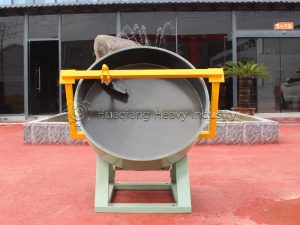
Unlike processes such as drum granulation, which require steam heating or high-temperature drying, the ambient-temperature operation of the disc granulator creates differences across three key aspects. First, it fundamentally ensures the survival rate of microbial strains. Research clearly indicates that physical granulation processes—such as disc granulation and extrusion granulation—involve adding microbial cultures directly to powdered organic matter; because the process is purely physical, the activity of the microorganisms remains intact after granulation. This mild granulation environment fully preserves the fertilizing efficacy of the bio-organic fertilizer. Second, it significantly reduces energy consumption. Granulation can be performed at ambient temperature without the need for additional drying equipment, cutting energy consumption per ton by more than 40%. Third, it substantially lowers the investment threshold. Disc granulators feature a simple structure—comprising a granulation disc, a variable-speed motor, a feed hopper, a liquid spraying system, and a support frame—with equipment costs only one-third to one-half of those for high-pressure granulation systems; furthermore, they do not require complex auxiliary drying or cooling units.
It should be noted that ambient-temperature granulation does not mean moisture management is ignored entirely. During the process, an appropriate amount of water or binder must be sprayed onto the material to facilitate the agglomeration of powder into granules. However, this water addition is merely a physical wetting step intended to provide the liquid volume necessary for pellet formation, rather than a precursor to heat-based evaporation. If the resulting wet granules have a high moisture content, subsequent low-temperature drying (usually below 60°C) or natural air-drying is still required to ensure storage stability. Even during this drying stage, temperatures must be strictly controlled to avoid compromising the product’s quality at the final step.
The disc granulator employs a simple, straightforward physical method to resolve the most challenging conflict in bio-organic fertilizer granulation: the need to form granules while simultaneously preserving microbial viability. Relying neither on high temperatures nor high pressures, it transforms loose powder into smooth, round granules through the ingenious interplay of a rotating disc and three distinct physical forces. For bio-organic fertilizer manufacturers, this is not merely a matter of equipment selection; it is a fundamental issue concerning the preservation of the product’s core value.