
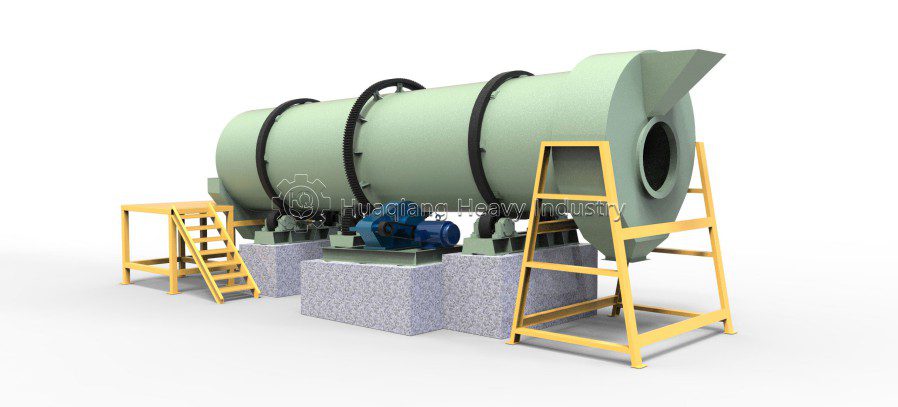
Rotary Drum Granulator
A drum granulator is a molding machine that can shape materials into specific shapes. The main working method of this equipment is wet granulation. A certain amount of water or steam is used to moisten the base fertilizer inside the drum, allowing it to undergo a full physicochemical reaction. Under certain liquid phase conditions, the rotation of the drum causes the material particles to agglomerate into spheres due to the compressive force between them. The drum body is lined with special rubber plates or acid-resistant stainless steel plates, achieving automatic descaling and nodule removal. Steam, gaseous ammonia, or phosphoric acid, nitrogen solutions, and phosphorus-ammonia slurries can be introduced into the drum to complete the chemical reaction and heating process for compound fertilizer granulation.
System composition and technical architecture
From an engineering perspective, the structural system of a rotary drum granulator is as follows:
(I) Machine Body: The most important part of the entire granulator, welded from high-quality medium carbon steel plates. The drum body is equipped with a large gear, a front belt, and a rear belt. The drum body is supported by the front and rear support roller devices via the front and rear belts.
(II) Transmission System: The main motor drives the reducer via belts and pulleys, which in turn meshes with a large gear ring fixed to the machine body via a split gear on the drive shaft.
(III) Support Frame: All rotating parts of the machine body are supported by the support frame. The support roller frame is welded from medium carbon steel plates and channel steel.
(IV) Spraying and Reaction System: Includes pipe beams, flexible rubber sheets, slurry sprayers, and ammonia distributors. A hot water pipe and a steam pipe are located at one end of the drum body.
(V) Feeding and Discharging Devices: Includes the feed pipe and discharge box.
Industry applications and process compatibility
Rotary drum granulators are suitable for cold and hot granulation, as well as large-scale production of high, medium, and low concentration compound fertilizers. In compound fertilizer production, high-concentration compound fertilizers can be produced through steam preheating and atomized spraying processes. In organic fertilizer production, they can process well-rotted livestock and poultry manure, straw, and other raw materials, retaining nutrient activity through low-temperature granulation. In the chemical industry, they can be used for granulation of products such as laundry detergent and catalysts. Furthermore, they are suitable for industries such as building materials, metallurgy, mining, ceramics, pharmaceuticals, and food.

Material adaptability analysis
The rotary drum granulator has a wide range of raw material adaptability. Compound fertilizer raw materials include: nitrogen sources such as urea, ammonium chloride, ammonium sulfate, and ammonium bicarbonate; phosphorus sources such as superphosphate, superphosphate, monoammonium phosphate, diammonium phosphate, and calcium magnesium phosphate; and potassium sources such as potassium chloride. Organic fertilizer raw materials include: fermented and decomposed chicken manure, pig manure, cow manure, and other livestock and poultry manure; straw powder, edible mushroom residue, distiller’s grains, medicinal residue, humic acid; and organic waste such as urban sludge. Industrial raw materials include: slag, coal powder, and iron concentrate. The equipment can process various materials with a moisture content of 25%-60%.
Core principles and granulation mechanism
The working principle of a rotary drum granulator can be understood from two levels: Mechanical and Technological.
Mechanical Level: The main motor drives a belt and pulley, which transmits power to the drive shaft via a reducer. A split gear mounted on the drive shaft meshes with a large gear ring fixed to the machine body. The drum rotates at a low speed (typically 3-25 r/min) supported by rollers. After entering the drum, the material rises and rolls along the drum wall under the combined action of centrifugal force, friction, and gravity, creating a complex motion.
Technological Level: Material is added from the feed end and repeatedly lifted and thrown down by the special internal structure of the drum (lifting plates, guide plates). During this process, a spray system evenly adds water or steam, causing the material to agglomerate into spheres under liquid phase conditions through interparticle compression. The granules tumble circumferentially while moving along the drum axis from the high end to the low end, finally being discharged from the discharge end. Due to the continuous intake of material and the continuous rotation of the granulator, continuous mass production is achieved.

Specifications and Selection Guidelines
The selection of a rotary drum granulator requires comprehensive consideration of production scale and raw material characteristics. Specifications: Small-scale processing: 1.2-1.5m (small model); Medium-scale production: 1.8-2.2m (medium model); Large-scale continuous production: 2.5m or larger (large model). Rotation speed: generally 3-25 r/min; Inclination angle: 3°-6° (adjustable); Output particle size: 2-8mm (adjustable); Granulation rate: ≥85%; Particle strength: ≥2MPa.
The following factors should be considered when selecting a model: production scale (daily processing capacity or annual output), raw material characteristics (moisture content, particle size, viscosity), finished product requirements (particle size, strength), process mode (cold granulation or hot granulation), site conditions (installation space, power configuration), and investment budget. The equipment can operate continuously for 24 hours and can be operated by 1-2 people.
Suitable candidates and purchasing recommendations
This product is primarily targeted at production managers and technical personnel in fertilizer plants, chemical plants, building material factories, and mining processing enterprises. It is recommended to conduct material testing before purchasing to confirm granulation performance. Additionally, it is important to assess whether the manufacturer provides installation guidance, personnel training, and after-sales service.
Capacity data and investment reference
The small one has an output of 5-10 tons per hour and is suitable for small organic fertilizer factories and cooperatives; the medium one has an output of 10-30 tons per hour and is suitable for small and medium-sized compound fertilizer plants and chemical companies; the large one has an output of 30-50 tons per hour and is suitable for large-scale production bases and solid waste treatment centers.
Models and parameters of rotary drum granulators
| Fertilizer Rotary Drum Granulator Machine | ||||||
| Model | Diameter(mm) | Length(mm) | Inclination(°) | Rotation Speed(r/min) | Capacity(t/h) | Motor Power(Kw) |
| ZG1.2*4.0 | 1200 | 4000 | 2.5 | 17 | 1-3 | 5.5 |
| ZG1.5*6.0 | 1500 | 6000 | 2.5 | 11.5 | 3-5 | 7.5 |
| ZG1.8*7.0 | 1800 | 7000 | 2.5 | 11.5 | 6-10 | 18.5 |
| ZG2.0*8.0 | 2000 | 8000 | 2.5 | 11 | 10-15 | 22 |
| ZG2.2*12 | 2200 | 12000 | 2.5 | 10.5 | 15-20 | 37 |