
[FAQ] Key Considerations for Establishing a Disc Granulation Production Line
The disc granulation production line is a mainstream configuration for organic fertilizer manufacturing; the quality of its construction directly impacts production efficiency, product quality, equipment lifespan, and operational costs. To help organic fertilizer enterprises avoid common pitfalls during construction and operation, we have compiled the following Q&A covering core aspects such as production line planning, equipment selection, installation and commissioning, raw material processing, operation, maintenance, and environmental compliance.
- Considerations for Production Line Planning and Site Layout
Q1: What core principles should be followed regarding site selection and layout when establishing a new disc granulation production line?
A: The site must be located away from residential areas and drinking water source protection zones, and must avoid ecologically sensitive areas. It should offer convenient transportation for the intake of raw materials and the shipment of finished products, as well as adequate drainage and power supply to prevent equipment damage from water accumulation during the rainy season. The layout should adhere to the principles of “smooth process flow” and “minimized material transfer distance,” arranging areas sequentially: raw material storage, pre-treatment, granulation, drying and screening, finished product storage, and auxiliary facilities. Maintenance aisles of 1.5–2 meters should be reserved between zones, and the placement of environmental protection facilities and fire access routes must be carefully planned to ensure production safety and regulatory compliance.
Q2: What factors should be considered when planning production capacity to avoid excess capacity or shortages?
A: Three key factors must be considered: First, raw material supply—determine the baseline capacity based on the annual collectable volume of local organic materials (such as livestock manure, crop straw, and mushroom residue) to avoid equipment idleness caused by material shortages. Second, market demand—assess the demand volume and application scenarios (e.g., field crops, fruits/vegetables, flowers) within the sales radius to set an appropriate capacity scale. Third, capital and site conditions—small and medium-sized enterprises might start with a small line producing 1–3 tons per hour while reserving space for future expansion, whereas large-scale enterprises can build lines producing 5–15 tons per hour based on demand, balancing capacity with capital utilization efficiency.
- Considerations for Equipment Selection, Installation, and Commissioning
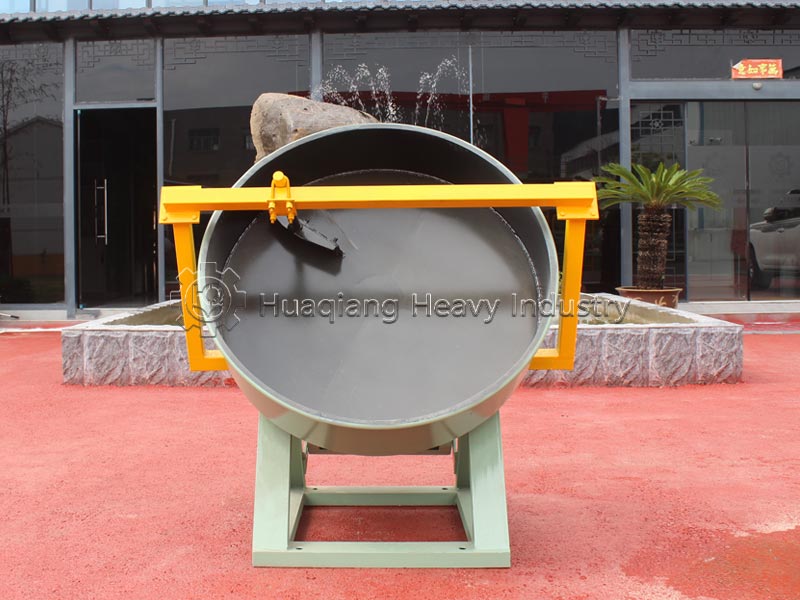
Q3: What core parameters and performance characteristics should be prioritized when selecting a disc granulator and its auxiliary equipment? A: For the core equipment—the disc granulator—four key parameters require attention: the disc diameter must match production capacity (choose a 2.2m diameter for 1–2 tons/hour, and 3.6m or larger for over 5 tons/hour); the disc angle adjustment range should cover 30°–55°; the rotation speed must be adjustable (15–25 rpm); and the granulation rate should be no less than 93%. Wear-resistant manganese steel is the preferred material, and the inner wall can be fitted with anti-stick polyurethane liners. Regarding auxiliary equipment, the crusher must suit the characteristics of the organic material (use a cage crusher for high-fiber materials and a semi-wet material crusher for high-moisture materials); the dryer must meet low-temperature drying requirements (60°C–75°C); and the screening equipment must accommodate a granule size of 2–8mm. Additionally, all equipment must possess corrosion- and wear-resistant properties.
Q4: What details must not be overlooked during the installation and commissioning of the disc granulation production line?
A: Before installation, verify the equipment foundation dimensions to ensure the foundation is solid and the levelness error does not exceed 0.5mm/m, thereby preventing excessive vibration during operation. During installation, ensure all connecting bolts are fully tightened and that the feed and discharge ports of the conveyors, granulators, and dryers are aligned, with gaps controlled to within 5mm to minimize material leakage. During commissioning, first conduct a no-load test run for individual machines to check component operation, noise levels, and temperatures. Once no anomalies are found, proceed to an integrated system test run. Focus on fine-tuning the match between the disc granulator’s angle/speed and the feed rate/moisture content, while simultaneously calibrating drying temperatures and screening precision to ensure uniform finished granules and compliant moisture content (10%–15%).
III. Precautions for Raw Material Pre-treatment and Granulation Operations
Q5: What are the specific requirements for raw material pre-treatment in disc granulation, and what are the consequences of inadequate pre-treatment? A: Raw materials must undergo thorough fermentation and decomposition; the moisture content after fermentation should be controlled between 28% and 35%. Excessive moisture causes material to stick to the disc and granules to clump, while insufficient moisture hinders granulation. Additionally, materials must be crushed to a particle size of less than 5mm, with hard impurities—such as stones, metal fragments, and plastics—completely removed. Inadequate pretreatment reduces the granulation rate and results in uneven granules; furthermore, hard impurities can wear down the disc’s inner walls and scrapers, shortening equipment lifespan and potentially causing jams or shutdowns, thereby increasing maintenance costs.
Q6: What key operational techniques and safety precautions should be observed when running a disc granulator?
A: Operational techniques: Start the equipment and wait for stable operation before slowly feeding material to avoid clogs caused by overloading; adjust parameters based on material viscosity—for high-viscosity materials (e.g., pig manure), increase the disc angle and lower the rotation speed, whereas for low-viscosity materials (e.g., sheep manure), decrease the angle and increase the speed. During granulation, spraying a small amount of water or adding 1%–3% binder (such as humic acid) can improve granulation results. Safety precautions: Operators must wear protective gear; it is strictly prohibited to open safety guards or reach into the disc to clear material while the machine is running. Do not overload the equipment, and immediately shut down and cut off power if any abnormalities are detected.
- Precautions for Drying, Screening, and Storage
Q7: What factors must be considered when drying organic fertilizer granules produced by the disc granulator to ensure fertilizer efficacy and quality?
A: The key is to use a low-temperature drying process, strictly controlling the temperature between 60°C and 75°C (and not exceeding 80°C) to prevent high heat from killing beneficial microorganisms in the material, which would reduce fertilizer efficacy. During drying, match the hot air volume with the feed rate to avoid incomplete or excessive drying; regularly clean out residual material from the drying equipment to prevent clumping and blockages; and allow dried granules to cool to ambient temperature before screening to prevent deterioration caused by the accumulation of hot granules.
Q8: What are the key considerations for screening organic fertilizer granules and storing the finished product?
A: Screening stage: Before operation, check the integrity and securement of the screen mesh; select the appropriate mesh aperture based on product requirements (4–6 mm for field crop fertilizer, 2–4 mm for flower fertilizer). During operation, ensure uniform feeding to prevent material accumulation on one side of the screen, and regularly clear away residual material to prevent clogging. Storage stage: The finished product storage area must be dry, well-ventilated, and moisture-proof; the floor should be hardened and fitted with moisture-proof mats. Stack finished products by specification, keeping the stack height under 2 meters to prevent granule breakage due to pressure. Monitor the storage environment to prevent moisture absorption and mold growth, and ensure proper labeling to facilitate inventory management.
- Equipment Maintenance and Troubleshooting Guidelines
Q9: What tasks are required for the daily and periodic maintenance of the disc granulation production line?
A: Daily maintenance: Before the shift, check connection bolts, drive components, and lubricant levels; after the shift, clear residual material from the equipment and wipe dust and oil stains from the surfaces. Periodic maintenance: Apply lubricating grease to drive bearings and gears every 7 days; inspect the inner wall of the disc for wear every 30 days and apply anti-corrosion/wear-resistant treatment if wear is severe; conduct a comprehensive inspection of the pulverizer screen, dryer lifters, and screening machine mesh every 90 days, replacing damaged parts promptly; perform a full overhaul of electrical equipment every six months, cleaning dust from wiring and checking electrical connections.
Q10: How should common issues such as material sticking to the disc and excessive vibration during production line operation be diagnosed and resolved?
A: Material sticking to the disc: First, check the raw material moisture content; if too high, add dry material or extend the fermentation time; if too low, spray an appropriate amount of water. Next, adjust the disc angle and rotation speed to enhance centrifugal force and material tumbling. Finally, clean residual material from the disc’s inner wall and inspect the lifters for damage, replacing them promptly if necessary. Excessive vibration: First, check if the equipment foundation is secure and level; reinforce and level it if loose. Next, tighten all connecting bolts. If the vibration originates from transmission components, adjust the belt tension, replace worn bearings or gears, and apply lubricating grease.
- Considerations for Environmental Compliance and Cost Control
Q11: What environmental protection facilities are required for a disc granulation production line to meet industry standards?
A: Three categories of environmental facilities are required: First, dust treatment facilities—installing bag-type dust collectors at raw material crushing, screening, and granulation stages to ensure dust emission concentrations meet national standards. Second, odor treatment facilities—installing biological deodorization or activated carbon adsorption units in fermentation and granulation areas to treat odors generated during production. Third, wastewater treatment facilities—treating equipment cleaning and floor washdown wastewater in sedimentation and filtration tanks to meet discharge standards before release or reuse; all organic waste must be recovered and utilized to achieve zero-pollution emissions.
Q12: How can operational costs for the disc granulation production line be reduced through standardized management?
A: First, optimize raw material pretreatment to improve utilization rates and reduce material transfer losses (keeping them within 5%). Second, reasonably adjust equipment operating parameters to avoid overloading and reduce energy consumption per unit of output (lowering it by over 20% compared to traditional methods). Third, strengthen equipment maintenance to minimize downtime due to breakdowns and extend equipment service life. Fourth, optimize staffing—assigning 1–2 operators for small lines and reducing manual labor on large lines through intelligent upgrades. Fifth, manage finished product storage effectively to prevent losses, while actively applying for subsidies for organic waste resource utilization to lower production costs.
VII. Considerations for Production Line Expansion and Upgrading
Q13: What key issues should be addressed when expanding an existing disc granulation production line? A: Before expansion, it is necessary to recalculate raw material supply and market demand to ensure the expanded capacity aligns with both; the layout of new equipment should be rationally planned in conjunction with the existing production line to avoid disrupting process workflows while reserving adequate space for maintenance and material handling. New equipment must be compatible with existing models and capacities to ensure smooth integrated operation. Upon completion, a comprehensive integrated commissioning of the entire production line is required to identify potential operational issues and ensure stable performance at the increased capacity.
Q14: What key factors should be considered when upgrading a disc granulation production line with intelligent technologies?
A: Prioritize equipment equipped with PLC control systems to enable automatic regulation of granulation parameters, drying temperatures, and feed rates, as well as real-time monitoring of operational status. Implement an intelligent monitoring system to provide visual oversight of the entire production process and automatic fault alerts. Ensure seamless integration between existing equipment and the new system to avoid compatibility issues. Additionally, provide training for operators on intelligent systems to ensure they are proficient in operation, commissioning, and basic troubleshooting, thereby fully leveraging the advantages of the intelligent equipment.
In summary, the establishment and operation of a disc granulation production line should adhere to the principles of “planning first, appropriate equipment selection, standardized operation, proper maintenance, and environmental compliance,” while carefully managing the requirements of each stage. Only through scientific construction and refined management can the production line achieve stable, efficient operation, improved product quality, and reduced operating costs—ultimately realizing a win-win for economic and environmental outcomes and supporting the sustainable development of organic fertilizer enterprises.