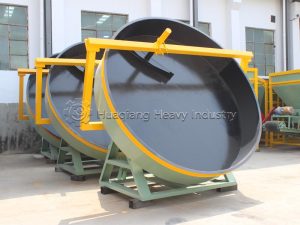
Methods for Determining Whether to Add Binder to Organic Fertilizer Disc GranulatorMachines
The methods for determining whether to add a binder to an organic fertilizer disc granulator machine are as follows:
- Assess the decomposition status of raw materials: Fully decomposed livestock manure, straw, and fungal residue possess high levels of organic matter and colloids, giving them inherent stickiness; they easily form granules after mixing and spraying with water, requiring no additional binder. Conversely, materials that are incompletely fermented, contain a high proportion of straw, or have high sawdust content feature loose fibers and lack colloids; the resulting granules tend to disintegrate, making the addition of a binder necessary.
- Measure material moisture content: When raw material moisture is controlled between 25% and 35%, the stickiness of the organic matter is fully utilized, allowing for successful granulation without breakage. If moisture is below 22%, the material is too dry to clump effectively—spraying water alone is insufficient—so binders like bentonite or humic acid must be added. If moisture exceeds the limit, the material may stick to the disc or form oversized clumps; in this case, binder usage can be reduced or eliminated.
- Observe granulation results: If fine powder particles fail to bond after rolling in the disc, the output crumbles upon light pressure, and screening yields a large amount of fine powder, then stickiness is insufficient and a binder is required. If granules are round and firm, do not crack easily when dropped, are uniform in size, and result in minimal fines for recycling, the material’s inherent stickiness is adequate, and no binder is needed.
- Consider the fertilizer formula and ratio: Formulas based on pure organic materials or high humic acid content possess inherent stickiness and do not require binders. For organic-inorganic compound fertilizers containing large amounts of mineral powder, chemical fertilizers, or clay additives, the inorganic powders lack binding capability and tend to separate; binders must be added to improve the granulation rate.
- Consider storage requirements for the finished product: If the fertilizer is to be used locally in the short term, slight looseness in the granules does not affect application, so binder usage can be minimized or omitted. However, if the finished product is to be bagged and sold for long-term use, it must withstand transport without breaking and storage without crumbling into powder; even if the raw material has decent stickiness, adding a small amount of binder is recommended to enhance granule strength. 6. Brief summary: Add a binder if the material is loose, forms poor-quality granules, produces excessive fines, or has a high proportion of inorganic raw materials; no binder is needed if there is sufficient decomposed organic matter, moderate moisture content, and stable granule formation.