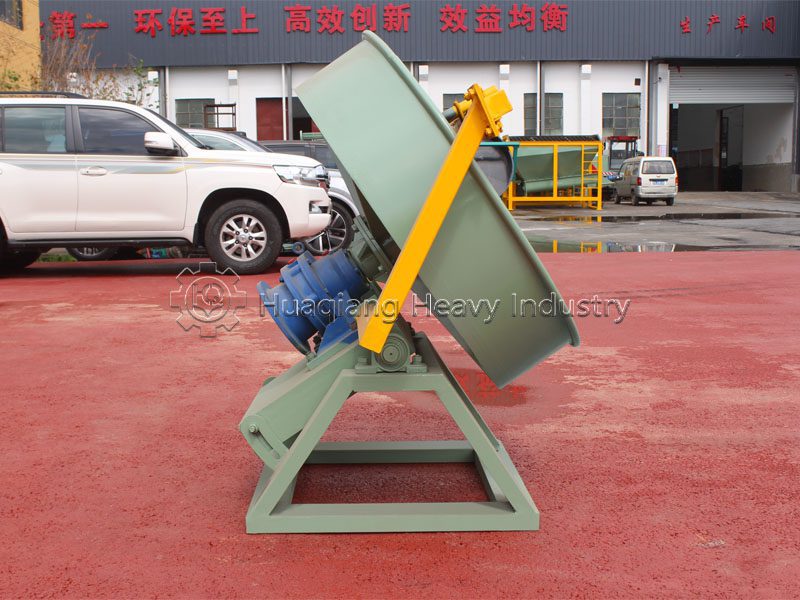
Key Factors Determining the Output of a Disc Granulation Production Line
The actual effective capacity of a disc granulation production line is not determined solely by the specifications of the main disc unit; rather, stable output is the result of four combined dimensions: raw material pretreatment, granulation operating conditions, auxiliary equipment, and operational management.
Raw material pretreatment forms the foundation of production capacity. Material fineness, moisture content, and uniformity directly influence the rate of granule formation. Powder that has been refined by a semi-wet pulverizer and thoroughly mixed with water in an organic fertilizer double axis mixer—resulting in uniform particle size and moisture maintained within the optimal 25%–35% range—exhibits rapid rolling agglomeration, minimal material recirculation, and high effective output. Conversely, if raw materials contain large hard lumps, exhibit moisture stratification, or possess excessive coarse fibers, the granulation disc is prone to forming large mud clumps and fine dust; the resulting need to recirculate and re-process large quantities of material significantly consumes production capacity. Adding binding agents such as bentonite or humic acid can enhance the pelletizing efficiency of the powder and reduce the volume of unproductive recirculated material.
The operating parameters of the main disc granulator unit are the core variables for adjustment. The coordination between the disc inclination angle, rotational speed, and water spray volume is crucial. An inclination angle of 35°–55° and a rotational speed (adjusted via variable frequency drive to match the disc size) ensure continuous rolling circulation of the material; meanwhile, atomizing nozzles must deliver a fine, uniform spray to prevent localized water accumulation and clumping. The condition of the wear-resistant scraper is equally critical; excessive clearance due to scraper wear leads to material sticking and an uneven disc surface, disrupting the material’s rolling trajectory and causing intermittent discharge, which directly reduces hourly output.
Downstream screening equipment acts as a constraint on the release of production capacity. If the rotary screen’s mesh aperture is mismatched, the screening area is insufficient, or mesh clogging is severe, large quantities of substandard granules are continuously returned to the granulation disc. This increases the equipment load and drastically reduces the line’s actual output; only by achieving efficient screening can finished products be diverted in a timely manner and the accumulation of recirculated material minimized.
The upstream feeding system determines operational continuity and stability. A screw feeder that delivers material at a steady, uniform rate ensures a balanced material layer thickness within the disc, facilitating smooth and continuous granule formation; conversely, inconsistent feeding rates or interruptions disrupt the growth rhythm of the granule nuclei, thereby lowering overall efficiency. In addition, factors such as equipment maintenance, workshop temperature and humidity, and the proficiency of operators in making adjustments can also have a minor impact on production capacity. Overall, the quality of raw material pre-treatment is the primary determinant, followed by the operating condition of the disc scraper and the efficiency of the screening system; achieving the equipment’s rated capacity requires the effective coordination of all three elements.