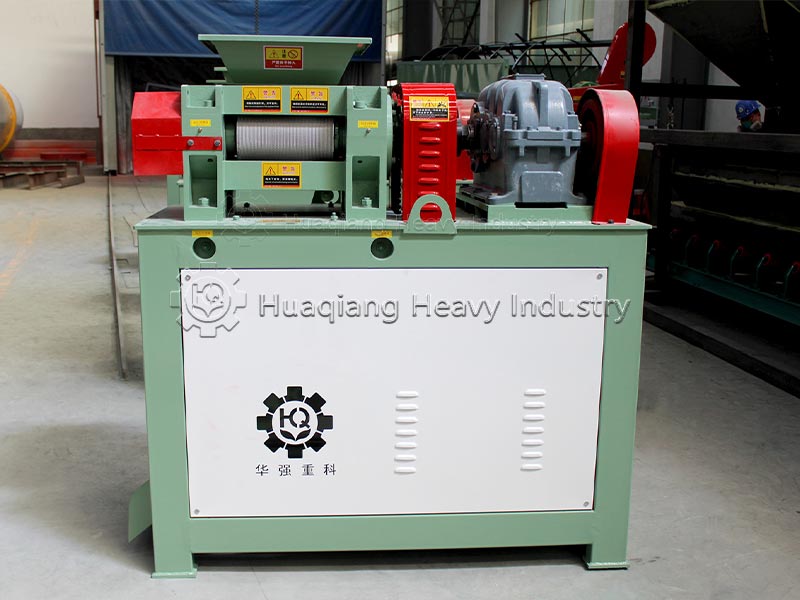
The Impact of Roller Gap Size on the Final Product of Double Roller Press Granulators
The gap between the two roller shells in a double roller press granulator is a critical parameter determining granule formation, output, the recycle rate, and hardness. Whether the gap is too wide or too narrow, it directly affects the quality of the finished product and the continuity of the roller press granulator production line; standard gap settings differ depending on whether dry NPK fertilizers or organic compound fertilizers are being processed.
If the gap is set too wide, the roller shells do not fit tightly together, preventing the material from being fully compressed. Powdered material only enters the roller pockets superficially, while the majority leaks directly through the gap, resulting in a large amount of loose fines and a sharp increase in the recycle rate, which drastically reduces the equipment’s actual production capacity. The resulting granules are highly porous and have very low hardness—crumbling upon slight impact—leading to significant losses during subsequent screening, conveying, and storage. Furthermore, the granules are misshapen, with a high proportion of broken corners and flattened fragments, resulting in poor product quality that is difficult to sell. Additionally, the recirculation of loose material increases the load on the downstream screening machine, making it prone to screen clogging and system shutdowns. The standard, optimal gap for processing compound fertilizers is 0.2–0.5 mm; exceeding 1 mm leads to the aforementioned issues.
If the gap is set too narrow, the roller shells are nearly in contact, causing the extrusion pressure to increase exponentially. While the material is forcefully compacted—resulting in dense, hard granules with an attractive, intact appearance—there are significant drawbacks. First, the load on the main unit surges, and motor current remains consistently high, making the system prone to overload trips and shutdowns. Sticky materials tend to adhere firmly within the roller pockets, making release difficult and necessitating frequent shutdowns for cleaning, which drastically reduces effective production time. Prolonged operation with an excessively narrow gap causes dry friction between the roller shells, doubling the wear rate; roller pockets wear smooth quickly, driving up the cost of replacement parts. Moreover, if the raw material contains hard particles like sand or stones, an excessively narrow gap can directly damage the roller surface, creating permanent indentations. When the gap is moderate and uniform, the material undergoes thorough compression and releases smoothly, resulting in full, rounded granules of optimal hardness and minimal fines recycling; the main unit operates steadily with stable current, and roller shell wear remains controllable. For dry fertilizer production, the gap is maintained at 0.2–0.5 mm; when processing organic compound fertilizer raw materials with higher moisture content, the gap can be increased to 0.5–0.8 mm to reduce roller sticking. Daily operations must also ensure gap synchronization on both sides; a discrepancy in the gap on one side leads to inconsistent granule sizes and severe uneven wear on the roller shells, thereby shortening their overall service life.