
Double Shaft Mixer
Our Services
Have a
project in
mind?
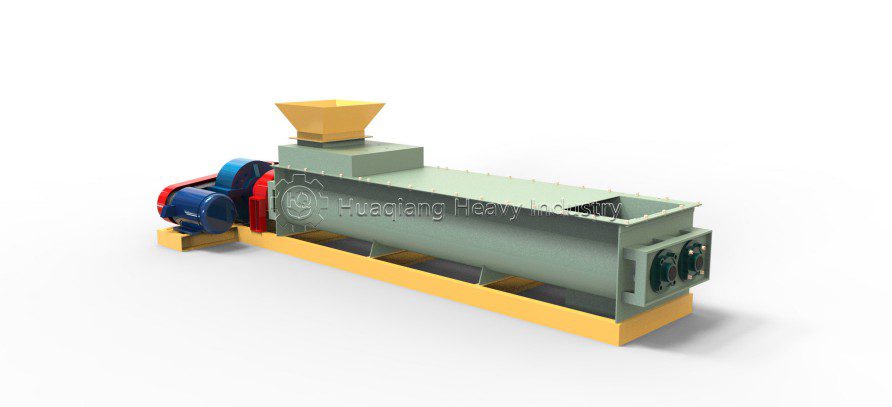
Double Shaft Mixer
Double shaft mixerss are among the most widely used mixing equipment in fertilizer production, organic waste treatment, and chemical processing. This equipment utilizes double axis counter-rotating spiral mixing as its core technology, integrating the advantages of high-efficiency mixing, large processing capacity, continuous production, and wear resistance. With its outstanding advantages such as high mixing uniformity, strong adaptability, environmentally friendly sealing, and simple operation and maintenance, the double shaft mixer has become a core piece of equipment for mixing powders, granules, and highly moist and viscous materials in industries such as fertilizers, chemicals, building materials, and mining.
Double shaft mixerss are a game-changer in organic fertilizer production, solving the problem of mixing highly moist and viscous materials. Livestock manure such as chicken, pig, and cow manure has high moisture content and high viscosity, while auxiliary materials such as straw and sawdust are loose and fibrous, resulting in significant differences in their physical properties. The double shaft mixer employs a twin-spiral shaft counter-rotating design, creating a powerful convection, shearing, and kneading mixing effect during operation. When faced with chicken, pig, and cow manure that have high moisture content and tend to clump together, the equipment can quickly break up the clumps and fully blend the sticky manure with dry straw, rice husks, microbial agents, and other auxiliary materials.
Hardware configuration and component functions
The hardware components of a double shaft mixer mainly include:
(I) Casing Assembly: Constructed from welded sheet metal and structural steel, it forms the supporting structure of the equipment.
(II) Mixing Shaft Assembly: Includes left- and right-hand rotating spiral shafts, bearing housings, blades, etc.
(III) Drive Assembly: Includes the electric motor, reducer, gears, and sprockets.
(IV) Atomizing and Humidifying Assembly: Includes stainless steel nozzles and water supply piping.
(V) Cover Plate and Inspection Assembly: Includes the cover plate and inspection holes.
(VI) Electrical Control Assembly: Includes the electrical control system and variable frequency speed control device.
Application footprint and audience distribution
Double shaft mixerss have a wide range of applications and target users:
Organic fertilizer production enterprises: Utilizing fermented livestock and poultry manure, straw, and mushroom residue to produce organic fertilizer. The equipment is typically located after the crushing process and before the granulation process. It can thoroughly blend viscous manure with dry straw, rice husks, and inoculants.
Compound fertilizer and blended fertilizer production enterprises: Utilizing nitrogen, phosphorus, and potassium powders and inorganic salt raw materials to produce compound fertilizer. It can effectively overcome the stratification and segregation problems of powders with different specific gravities and particle sizes.
Bio-organic fertilizer and special functional fertilizer production enterprises: Suitable for liquid addition operations. By installing atomizing nozzles on the top of the tank, amino acids, humic acid, etc., can be evenly sprayed onto the surface of the material.
Chemical enterprises: Mixing powders for fine chemicals, fertilizers, and additives.
Thermal power plants and mines: Humidifying and loading fly ash or similar materials.
Material range and processing capacity
Double shaft mixerss can process a wide range of materials, including powders, granules, and highly moist and viscous materials.
Organic materials: Chicken manure, pig manure, cow manure, sheep manure, straw powder, mushroom residue, and biogas residue.
Fertilizer materials: Nitrogen, phosphorus, and potassium powders, compound fertilizer raw materials, and inorganic salts.
Industrial materials: Fly ash, mineral powder, and feed ingredients.
Operating Mechanism and Hybrid Principle
The double shaft mixer operates based on the synergistic effect of “synchronous counter-rotation of two shafts + three-dimensional convection mixing.” Driven by a transmission device, the two mixing shafts rotate synchronously in opposite directions. The outer spiral pushes the material from both ends towards the center, while the inner spiral returns the material from the center back to both ends. This dual-shaft interaction creates three-dimensional convection within the drum. A misting humidification system further enhances the uniform humidification of the material. The entire process achieves integrated, continuous operation of mixing, humidification, and conveying.
Hybrid process and production line coordination
Double shaft mixerss play a crucial role in production lines across various industries. The front end of the equipment can be connected to crushing and screening equipment; the equipment efficiently mixes, humidifies, and conditions materials; after the mixed materials meet the required uniformity, they proceed to subsequent granulation and packaging processes. The equipment can seamlessly integrate with crushing, fermentation, and granulation equipment, forming a one-stop automated production line of “raw material crushing-mixing-granulation,” eliminating the need for manual material handling. It supports 24/7 uninterrupted stable production and is fully adaptable to the needs of large-scale production.