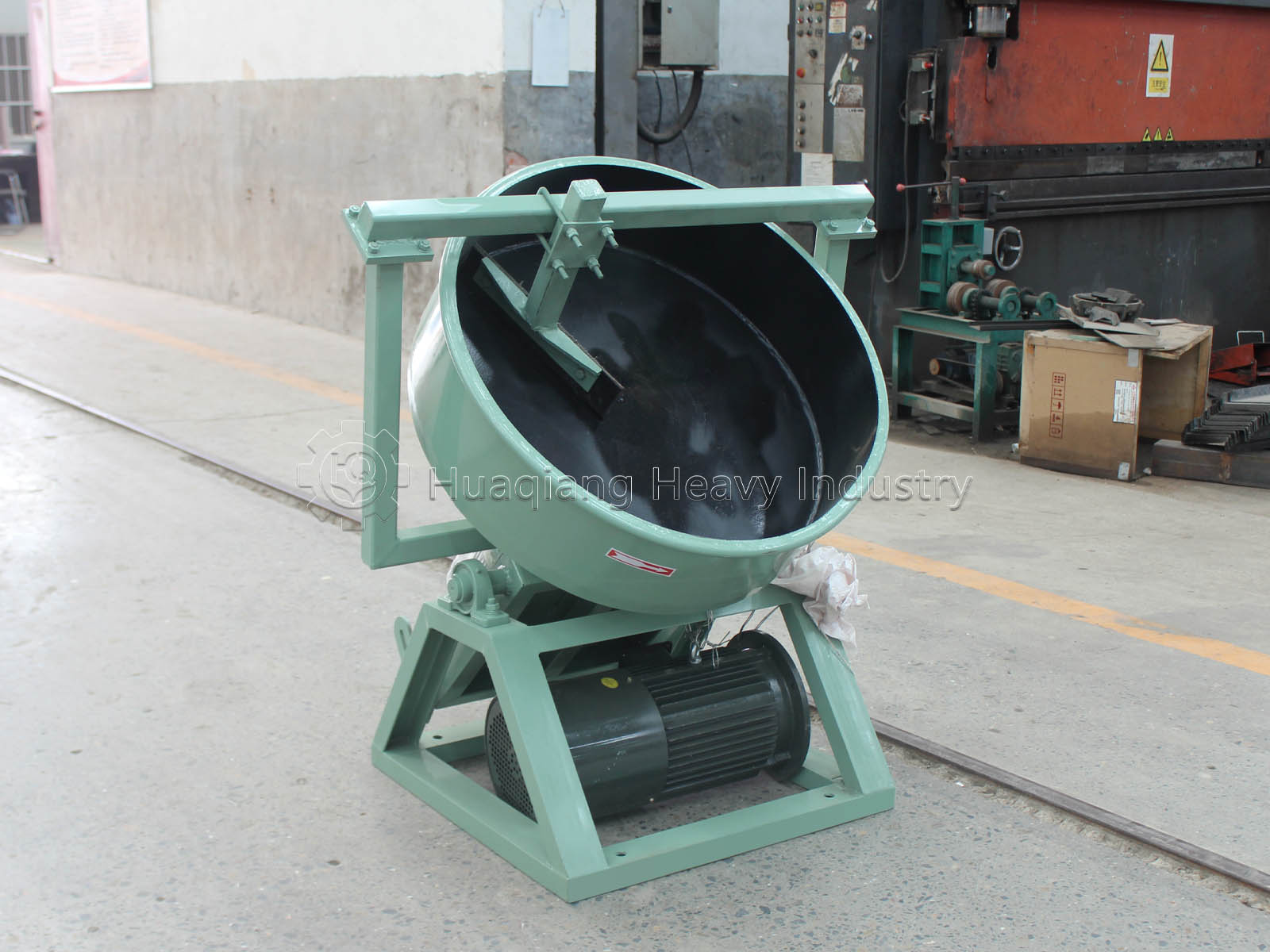
Core Functions of the Scraper in Organic Fertilizer Disc Granulators
The cleaning scrapers used with disc granulators—comprising a fixed main scraper and an auxiliary side scraper—are critical components for ensuring continuous, stable granulation and improving pellet quality. They serve four primary functions:
First, removing adhered wet material from the disc surface to prevent buildup, caking, and disc fouling. Organic fertilizer raw materials often have high moisture content and high organic viscosity; during rotation, powder easily sticks to the disc bottom and walls. Without timely cleaning, this material accumulates into an uneven, hard layer. The scraper continuously sweeps the surface, keeping the metal clean and smooth. This prevents localized buildup from disrupting the material’s rolling trajectory, fundamentally reducing the need for shutdowns to clean fouled discs and significantly increasing the effective production time of the bio-organic fertilizer equipment. The scraper’s cleaning action is particularly crucial when processing high-fiber or high-moisture materials like chicken manure and sludge.
Second, regularizing the material’s rolling path to stabilize the formation of “seed pellets” (nuclei). If lumps form on the disc surface, material drifts off-course or clumps together, preventing the uniform formation of fine seed pellets. The scraper smooths the surface in real-time, ensuring all material rolls cyclically along the designed tilt angle. Fine powder makes full contact with the atomized water mist, resulting in uniform, stable seed pellet formation; this reduces the occurrence of large mud clumps and loose fines, thereby lowering the proportion of material requiring recycling. Without a scraper—or if the gap caused by scraper wear is too large—large clumps of wet material accumulate at the disc edge, leading to inconsistent particle sizes.
Third, breaking up caked material to assist in uniform granulation. Fermented organic fertilizer often contains small, hard clumps; if these adhere to the disc bottom and undergo repeated compression, they can turn into oversized mud balls. The scraper blade lightly shears and breaks up these clumps and solidified wet masses. The resulting fines re-enter the granulation cycle, reducing irregularly shaped or substandard particles, improving the final product’s appearance, and easing the load on the subsequent screening process.
Fourth, controlling the material layer thickness to regulate particle size. Adjusting the gap between the scraper and the disc surface allows for control over the thickness of the powder layer remaining in the disc. A smaller gap results in less material accumulation on the disc and a shorter residence time, yielding smaller granules; conversely, a wider gap increases the material bed thickness and extends the time for rolling and kneading, facilitating the formation of larger organic fertilizer granules. This allows for flexible adjustment of granule size without altering the rotation speed, inclination angle, or spray volume.