
Three Time Philosophies in Fertilizer Production
Walking into different fertilizer plants, you’ll experience completely different production rhythms. Some production lines resemble express delivery sorting centers, with machines spinning at dizzying speeds; others are like handicraft workshops, where materials slowly roll several times on discs before taking shape; still others are like printing plants, where under high pressure, it’s over in a flash. The NPK blending fertilizer production line, disc granulation production line, and fertilizer roller press machine correspond precisely to three time philosophies: fast, slow, and instantaneous.
The blending line believes in “striking while the iron is hot.” The raw materials are already granules, requiring no morphological modification; the only task is to mix them according to the formula. The entire process, from weighing to packaging, takes only a few minutes, and a single line can process tens of tons of finished product per day. This speed stems from “no unnecessary work”—since the urea plant has already produced good granules, why bother reshaping them? For fertilizer mixing plants that only start up after receiving an order and change their formulas daily, even a minute’s delay could mean losing a customer.
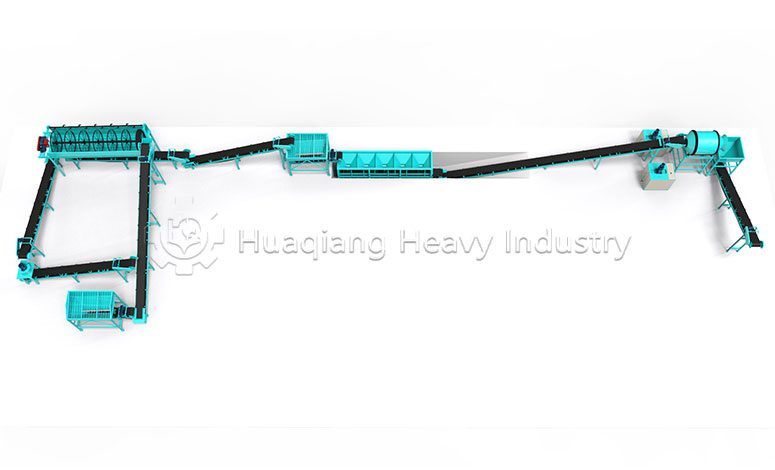
The disc extrusion line takes a different approach—”slow and steady wins the race.” The material tumbles, absorbs, and grows on the inclined discs, round and round, requiring patience. Too high a speed and the granules fly out; too steep an angle and the material slides down; too much water and they clump together; too little and they don’t grow. Operators must constantly monitor the material’s condition and make meticulous adjustments, tending to it like gardening. But the slow pace pays off—the produced granules are perfectly round and uniform, with a smooth surface, like holding a handful of black pearls. Manufacturers of high-end organic fertilizers and export horticultural fertilizers are willing to invest time in achieving this “marketability.”
The roller extruder, on the other hand, is a believer in “instant bursts of speed.” The powder is fed in, passes through a high-pressure zone between the two rollers for a fraction of a second, and emerges as a compressed cake. The entire process is done without adding a drop of water or raising the temperature by a single degree—it’s that clean and efficient. Its speed differs from that of the blending line—blending speed is achieved through simplified processes, while extrusion speed is achieved through instantaneous energy release. Only this kind of instantaneous process can handle those “delicate” formulas that deliquesce when exposed to water or melt when heated.
Each of the three production lines has its own time scale. The fertilizer blending station races for minute-level speed, the disc mill maintains hour-level patience, and the extrusion line competes for millisecond-level power. No single pace is inherently superior; it all depends on what your raw materials and customers prefer. Ultimately, fertilizer production is about making choices in the time dimension—where you want the granules to remain, for how long, and how you want them to meet.