
Three Textures of Granules
If you had the chance to touch fertilizer granules produced by different machines, you would find their “personalities” are completely different. Granules from the NPK Blending Fertilizer Production Line feel smooth and round, each one retaining its original edges, like a freshly opened glass marble; granules from the Double Roller Press Granulator have fine indentations on their surface, feeling heavy in your hand, like a compressed pill; while granules from the disc granulation production line are uniformly spherical, and holding a handful in your palm, you can feel the deliberate uniformity. These three textures correspond to three completely different “granule perspectives.”
The blending line treats granules with “respect.” In the eyes of this production line, every urea or diammonium phosphate granule bought from the chemical plant is a perfect finished product; they don’t need to be modified, they just need to be “arranged.” The multi-compartment static scale acts like a meticulous housekeeper, carefully selecting different types of granules according to the formula, weighing them accurately, and then dumping them all into the mixing chamber. The mixer’s blades rotate at an extremely low speed, allowing the granules to briefly touch each other before quickly separating—the entire process is so gentle that it doesn’t even break the surface coating of the granules. Behind this “reverence” for the raw material granules lies a clear understanding: the best granules are those that remain intact; any unnecessary manipulation is a loss of quality.
The extruder, on the other hand, is completely different; it believes in “no destruction, no construction.” The loose powder is fed in, passes through the high-pressure zone between two rollers, and is instantly compressed into a thin disc with doubled density. The indentations and irregular cross-sections on the granule surface are the “birthmarks” of the extrusion process—they may not be as aesthetically pleasing as those from disc granulation, but each indentation records the process of molecules being forced to approach and forcibly shake hands. The extruder makes no secret of its roughness, knowing that for delicate materials that dissolve in water or become sticky in heat, this seemingly unreasonable brute force is actually the gentlest solution.
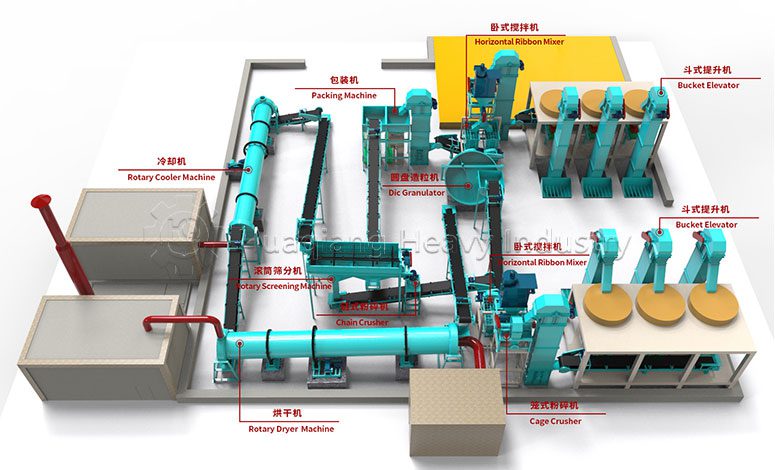
The disc granulator, on the other hand, is the most patient. It doesn’t handle the finished granules or press them into powder; instead, it “nurtures” the granules from scratch—on the tilting, rotating disc, tiny powder cores, enveloped in atomized water vapor, roll, absorb, and grow in circles. The allure of this process lies in its unpredictability: with the same rotation speed, the same tilt angle, and the same amount of water, the granules produced today and tomorrow may have slightly different particle size distributions, because the material’s moisture content, temperature, and humidity all subtly influence pelleting behavior. Disc-produced granules are perfectly round and plump, with the best appearance, but they are also the most delicate; a slight mishandling during transport can easily wear off a layer of skin.
Behind these three types of granule textures lies the most basic truth of the fertilizer processing industry: no single process is universally applicable; only what is suitable or unsuitable. If you’re dealing with finished granules as raw material, don’t bother with any fancy processing; go for the blending line. If you’re dealing with powders that are sensitive to water and heat, then let the extruder handle the “hard-hitting” process. If you have fermented organic material and want to sell it for a good price, then slowly “nurture” it using a disc press. The feel of the granules will tell you where they came from, what they’ve been through, and what role they’re best suited to play.