
Three Approaches to Fertilizer Granulation: Rolling, Pressing, and Combining
Stepping into a fertilizer production workshop, you’ll find that granulation equipment is more “unique” than you might imagine. The same raw materials, processed by different machines, produce granules with subtle differences in shape, hardness, and even color. The disc granulator, fertilizer roller press machine, and new type two-in-one organic fertilizer granulator represent three distinct approaches to granulation technology.
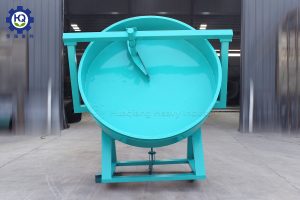
The disc granulator follows a “rolling” approach. Its core is a large, tilted disc. Powdered material is added from above and, within the disc, is subjected to centrifugal force, friction, and gravity, repeatedly tumbling along a parabolic trajectory. Simultaneously, atomizing nozzles evenly spray water onto the material surface, causing the moistened fine powder to gradually envelop and grow like a snowball. When the granules reach the target particle size, they automatically roll off the edge of the disc and are discharged. The tilt angle and rotation speed of the disc granulator are adjustable—a smaller tilt angle results in longer material residence time and larger particles, while a higher rotation speed leads to stronger centrifugal force and denser particles. The processing capacity of a single disc granulator ranges from 1 to 15 tons per hour, with a pelletizing rate typically between 70% and 85%. The advantage of this process is the roundness and good appearance of the pellets, making it particularly suitable for the production of organic fertilizers and organic-inorganic compound fertilizers. However, its disadvantages are also obvious—it requires the addition of water, necessitating subsequent drying and cooling equipment, and the entire production line involves many steps and occupies a large area.
The roller extruder takes a different approach—”pressing.” Unlike the “wet pelletizing” of disc granulation, roller extrusion uses a purely dry process. Two high-pressure rollers rotating in opposite directions directly press the dry powder material into a thin cake, which is then crushed and screened to obtain the finished pellets. The entire process involves no added water and no temperature increase, allowing the material moisture content to be as low as below 1%. Common models have installed power ranging from 7.5 to 45 kilowatts, with production capacities from 1 to 15 tons per hour. By eliminating the drying stage, the energy consumption and investment of the entire process line are significantly reduced. However, the extruded granules have sharp edges and a less rounded appearance compared to disc granulators.
The new two-in-one organic fertilizer granulator attempts to find a third way between “rolling” and “pressing”—”combination.” This equipment integrates the two core processes of mixing and granulation into a single machine. For coarse fibrous materials such as fermented livestock manure, straw, and distiller’s grains, it uses high-speed rotating internal agitators to forcefully shear, knead, and compress the materials, continuously mixing, granulating, and even rounding the fine powder within the machine. The granulation rate can reach 80% to 90%. More importantly, it can directly process wet materials with a moisture content of 25% to 45%, without the need for pre-drying and fine grinding. Traditional processes require four machines connected in series: a toothed mixer, an elevator, a buffer silo, and a granulator. The two-in-one machine, however, only needs one unit to complete both molding steps, reducing equipment procurement costs by 30% to 50%. For small and medium-sized organic fertilizer processing plants with limited space, low budgets, and demanding raw materials, this approach is clearly more practical.
Three types of equipment, three approaches. Disc granulation prioritizes “roundness,” roller extrusion prioritizes “efficiency,” and the two-in-one prioritizes “simplicity.” None is inherently superior; each is simply more suitable for your raw materials and budget. Ultimately, fertilizer granulation is about finding the optimal balance among a host of constraints.