
The Journey of Granules: A Three-Stage Relay from Farm Recycling to Precision Application
If you’ve ever picked up a handful of fertilizer and examined it closely, you’ll find that almost all of them are round granules. But few people ask: where do these granules come from? Their origins are actually vastly different—some come from mountains of chicken and pig manure on the outskirts of cities, reshaped after a long fermentation process; some are industrial nitrogen, phosphorus, and potassium powders that are instantly compressed into flakes under high pressure and then crushed and screened; and some don’t even need granulation at all, simply a combination of several ready-made granular fertilizers in a specific ratio. These three distinct “birth stories of granules” correspond precisely to three technological paths: agricultural waste resource utilization, industrial powder forming, and precise formula compounding. The hydraulic compost turning machine, the double roller press granulator, and the NPK blending fertilizer production line are the indispensable “protagonists” in these three pathways, collectively forming a relay race from field collection to field application.
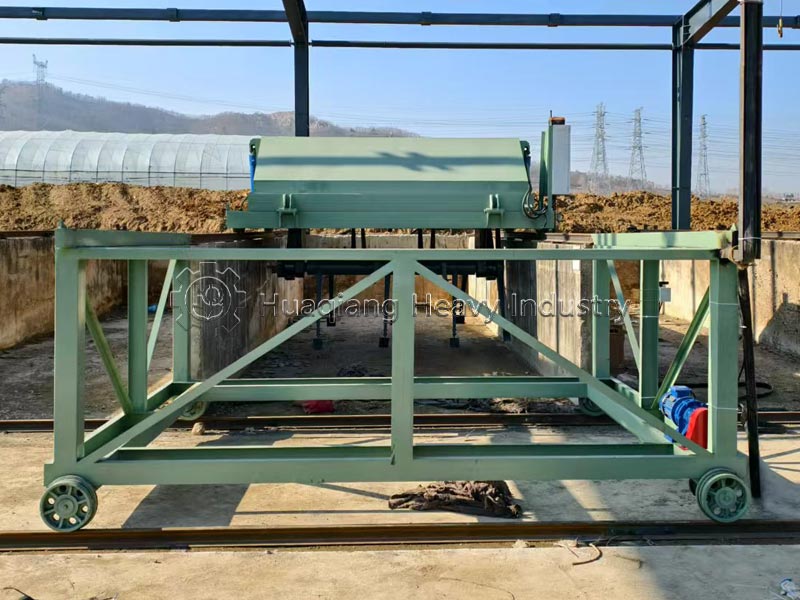
The first leg is passed to the hydraulic compost turning machine, whose stage is not in a factory workshop, but in open-air fermentation tanks or windrows. There, fresh chicken manure with a moisture content exceeding 60%, sticky sludge, or fibrous bagasse are piled up—materials that, if returned to the field directly without treatment, will undergo secondary fermentation in the soil, burning roots and seedlings, and the insect eggs and antibiotic residues they carry will further contaminate the farmland. The hydraulic compost turning machine’s job is to periodically turn the pile from bottom to top and from inside to outside during the 20-30 day aerobic fermentation cycle. A high-efficiency compost turner can precisely adjust its travel speed and turning depth, with a single unit capable of processing hundreds of tons per day, making it a truly tireless fermentation manager. After being repeatedly processed by it, the decomposed material is no longer smelly waste, but a handful of dark brown organic raw materials exuding the fresh scent of earth—the very foundation for the next generation of granular fertilizer.
The second step involves the double Roller Press Granulator. The mission of this granulator is to give these powders a “physical identity”—by using two high-strength rollers rotating in opposite directions, it instantly compresses the material into thin cakes under pressure of hundreds of megapascals. This extrusion process requires no water or chemical binders; it relies purely on external force to shorten the particle spacing to a distance where intermolecular forces can “hold hands.” The extruded cakes are then broken up by a crushing and granulation system, and finished granules meeting the standard particle size are screened out. The remaining fine powder is returned to the rollers for further extrusion.
However, not all fertilizers require granulation from scratch. In modern fertilizer blending stations where formulation requirements are constantly changing and order batches are flexible, the NPK Blending Fertilizer Production Line offers another, more direct approach: it doesn’t produce new granules, but rather “blends” existing ones. This production line uses commercially available base fertilizers such as urea granules, diammonium phosphate granules, and potassium chloride granules as raw materials. A multi-bin batching system automatically weighs the materials according to soil testing formulations, and then feeds them into a twin-shaft paddle mixer for rapid physical blending.