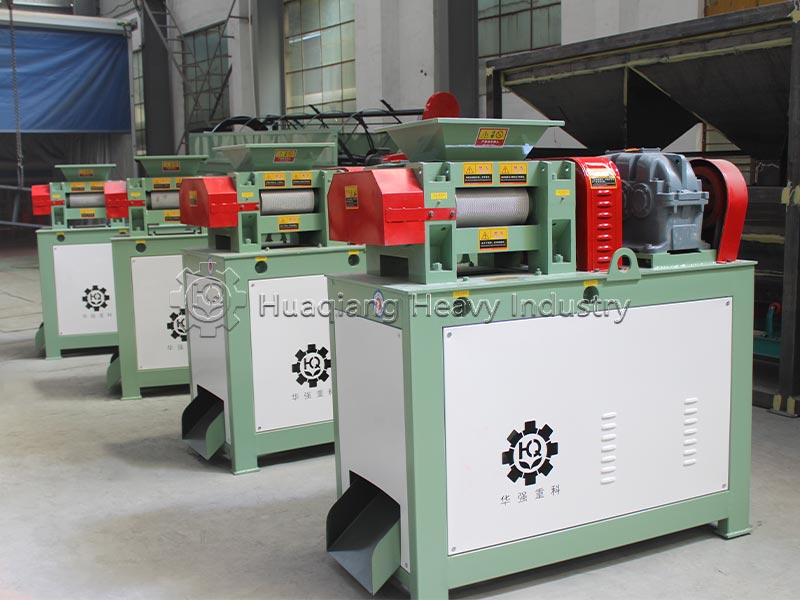
Screen Selection for Double Roller Press Granulators
The screens used with double roller press granulators are mainly used for particle grading and return material recycling. Selection must be based on the finished particle size, material characteristics, and equipment operating conditions, controlling factors such as aperture size, material, structure, and installation.
First, determine the aperture size, which is the core of selection. First, clarify the finished particle standard. For mainstream organic fertilizers, a 2.5–4mm aperture is suitable; for large-particle fertilizers, 4–6mm is appropriate; and for small particles, 1.8–2.5mm is suitable. The aperture size for return material screening should be slightly smaller than the finished particle size to ensure smooth return of unformed powder and broken particles for reprocessing, and normal discharge of qualified particles, avoiding particle size mixing. The aperture should not be too small, otherwise it will easily be clogged by fine powder and wet materials, reducing screening efficiency.
Second, select the appropriate material. For conventionally dried inorganic and organic fertilizers, ordinary carbon steel perforated screen plates are suitable, offering high cost-effectiveness and strong hardness. For materials with high moisture content, containing humic acid or slightly corrosive components, 304 stainless steel is preferred due to its rust resistance, non-stick properties, and extended service life. In applications where raw materials contain hard lumps or coarse fibers, manganese steel screen plates must be selected. These are impact-resistant, wear-resistant, and effectively prevent screen surface deformation and cracking, making them suitable for high-load continuous production.
Furthermore, the screen structure type should be considered. Roller Press granulator production lines often use drum screens or linear vibrating screens. For these, integral perforated screen plates are preferred due to their regular gaps, reduced wire breakage, and significantly better vibration resistance than woven mesh. In scenarios prone to clogging, choose models with wide ribs and large hole spacing, combined with an internal bouncing ball unclogging structure to reduce material adhesion and blockage. Woven screens are only suitable for fine particles and low-abrasion materials; they are not recommended for heavy-duty applications.
Finally, installation and compatibility must be considered. The screen size and curvature must perfectly match the equipment frame. After installation, ensure proper tension, without loosening or warping, to prevent friction damage during operation. In dusty and high-humidity environments, increase the screen plate thickness to improve structural strength. By comprehensively selecting the appropriate screening method based on the dryness, wetness, and impurities of the raw materials, and by regularly carrying out standardized cleaning, the screening effect and service life can be significantly improved.