
【FAQ】Blended Fertilizer or Bio-organic Granular Fertilizer? Production Line Positioning Determines Equipment Selection
Equipment selection for a fertilizer production line is not essentially a competition of equipment performance, but rather a matter of implementing product positioning. Investing in the same production line for blended fertilizer and bio-organic granular fertilizer will result in drastically different equipment configurations, process routes, and investment priorities. The following analysis examines the core differences between the two production lines to understand the correspondence between equipment selection and product positioning.
Blended Fertilizer Production Line: Accurate Formula is the Only Standard. Blended fertilizer (BB fertilizer) does not alter the physical form of any raw materials; it focuses on one thing—precisely weighing and uniformly mixing the nitrogen, phosphorus, and potassium base fertilizers according to the formula. The entire production line operates around “accurate formulation and uniform mixing.” After being weighed by a high-precision metering system (error ±0.2%), the raw materials enter a twin-shaft paddle mixer for three-dimensional tumbling and mixing, achieving a uniformity of over 95%. The entire production line requires no heating, no drying, and no chemical reactions; the process flow is short, the footprint is small, and energy consumption is low. The core challenge lies in preventing segregation of different raw material particles due to differences in specific gravity and particle size—therefore, strict control of incoming particle size is required, and the average particle size of each raw material must be similar.
Bio-organic granular fertilizer production line: Survival is more important than shaping. Unlike blended fertilizers, the production of bio-organic granular fertilizer involves a granulation and shaping process. The production line is centered around a disc granulator, where materials, after mixing, roll into granules on an inclined rotating disc. However, the real difficulty of this production line is not in the “granulation rate,” but in “activity retention”—functional bacteria are extremely sensitive to temperature; after conventional high-temperature granulation, the survival rate is only 30%~50%, while disc granulation, conducted at room temperature (30~55℃) throughout, can achieve a survival rate of over 80%. This requires the entire production line to adhere to the low-temperature principle in subsequent stages (such as drying), forming a complete “low-temperature granulation, room-temperature shaping” process chain.
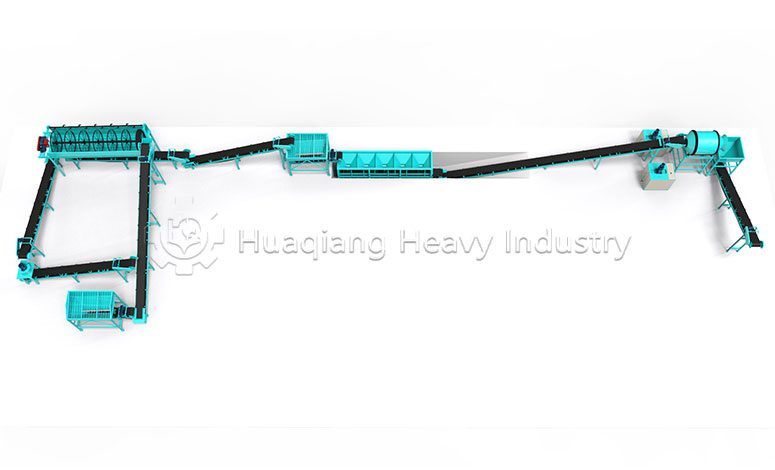
The product flows of the two production lines are different. The blended fertilizer production line produces formulated, fast-acting fertilizers with high nutrient concentrations and targeted application, suitable for on-demand application to field crops. The bio-organic granular fertilizer production line produces soil-improving products that combine organic matter and functional bacteria, suitable for cash crops and soil remediation applications. These two types of fertilizers are not substitutes in the market, but rather complementary—with the diversification of planting structures, more and more fertilizer companies are choosing to maintain both production lines simultaneously to cover a wider product matrix.
Two models of production line synergy. If two production lines coexist, flexible synergy can be achieved: the disc granulation line produces organic granules, which are then fed as one of the raw materials to the blending line and mixed with chemical fertilizer granules in a specific ratio to produce organic-inorganic compound fertilizer. In this model, the two core pieces of equipment leverage their respective advantages—the disc granulator solves the problem of organic material shaping, and the NPK blender solves the problem of precise formulation. The product line expands from a single chemical or organic fertilizer to a diversified matrix of “pure blended fertilizer + pure organic granules + organic-inorganic compound fertilizer,” allowing the same production line to cover a wider range of market demands.