
【FAQ】Can precise formulation and the preservation of biological activity be achieved on the same production line?
In fertilizer production, “precise formulation” and “maintaining biological viability” represent two distinct process objectives. The former concerns the accurate execution of NPK formulas, while the latter focuses on the survival of functional microbes in bio-fertilizers. Whether both can be accommodated on a single production line depends on the understanding of equipment selection and process workflows.
The core requirement for BB (Bulk Blend) fertilizer lines is “precise proportioning and uniform mixing.” NPK blending lines utilize a purely physical mixing process, combining nitrogen, phosphorus, potassium, and secondary/micro-nutrients according to a precise formula. The line consists of a series of components: raw material silos, a metering system, mixing equipment, and a packaging machine. Granular raw materials—such as urea, monoammonium phosphate (MAP), and potassium chloride—are stored separately; during production, electronic scales weigh them precisely according to the formula, keeping margins of error minimal. The materials then enter the NPK blender; mainstream models feature a twin-shaft paddle design where the shafts rotate in opposite directions, creating a three-dimensional tumbling motion that achieves a mixing uniformity of over 95%. The mixing time per batch is approximately five minutes. Matching raw material particle sizes is crucial to preventing segregation; the granules of urea, phosphates, and potash must be similar in size, otherwise, stratification will occur during subsequent conveying and packaging, even if the initial mix was uniform.
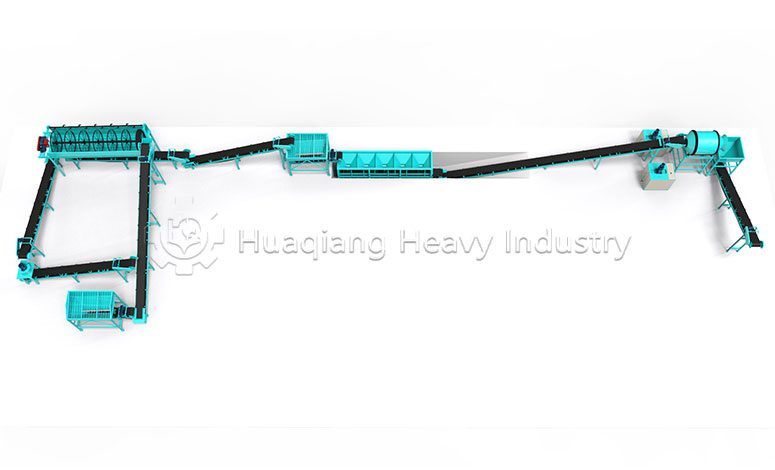
The challenge with bio-organic fertilizer lies not in the mixing, but in keeping the microbes “alive.” Unlike the purely physical mixing used for BB fertilizers, the core challenge for bio-organic fertilizer disc granulators is protecting the activity of beneficial microorganisms during the granulation process. Organic raw materials are characterized by high fiber content, high moisture, and low density, making it difficult for them to naturally form stable granules. The value of the disc granulator lies in its gentle, cyclic rolling granulation technology: materials agglomerate into spheres through natural rolling on an inclined, rotating disc. Since no high temperatures are generated during the process, beneficial microorganisms in the organic material remain unharmed, perfectly preserving the fertilizer’s biological activity and soil-improving properties. Operators can flexibly adjust the disc’s inclination angle and rotation speed to produce granules of various specifications, achieving a granulation rate of over 93%. Production lines can be configured in two ways based on their intended function. If the primary goal is to produce formulated blended fertilizers, priority should be given to an NPK blending line featuring an NPK mixer as the core equipment; conversely, if the objective is to process organic waste into bio-organic granular fertilizer, the production line should be built around a disc granulator. These two approaches can also be flexibly combined—using the bio-organic granules produced by the disc granulator as a raw material for the BB fertilizer line and blending them in specific proportions—thereby diversifying the product range.