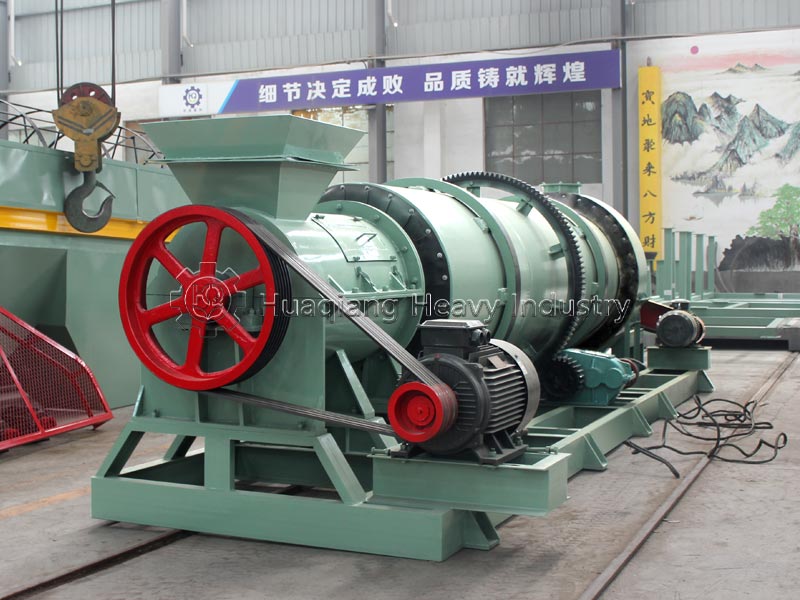
Reasons for Loose Particles and Low Pelletizing Rate Produced by the New Type Two in One Organic Fertilizer Granulator
The core reason for the loose particles and low pelletizing rate produced by the new type two in one organic fertilizer granulator is that the material agglomeration conditions are not up to standard. The main reasons are as follows:
The material itself is key. First, moisture content control is crucial, with an ideal range of 28%-35%. Too low a moisture content prevents the formation of effective “liquid bridges” between powder particles, causing them to stick together; too high a moisture content turns the material into a slurry, making it difficult to form. Second, insufficient raw material fineness (such as excessively long straw fibers or particles not passing through a 40-mesh sieve) will act like a skeleton, separating the particles and resulting in a loose structure. Furthermore, insufficient material binding force (such as excessive carbon content) requires the addition of appropriate amounts of binders such as humic acid.
Equipment and operation are another major factor. A mismatch between the stirring and granulation speeds will lead to uneven mixing or insufficient kneading force, preventing the material from being compacted into pellets layer by layer. Insufficient feed (low filling rate) results in a lack of mutual compression within the machine, making agglomeration difficult. After prolonged operation, wear on the agitator teeth can lead to excessive gaps between them and the cylinder wall, reducing the extrusion force and causing compacted granules.
Process conditions are also crucial. If the raw material fermentation is incomplete, undecomposed coarse fibers will compromise the compactness of the granule structure, similarly affecting pellet strength.
To resolve this, first check and adjust the material’s moisture content and fineness to ensure the basic conditions for bio-organic fertilizer granulation are met; then verify that parameters such as equipment speed and feed rate are within reasonable ranges; finally, check the condition of easily worn parts such as the agitator teeth and maintain or replace them promptly.