
Professional Fertilizer Production Equipment: Comprehensive Analysis of NPK Blending Production Line and Bio-organic Fertilizer Disc Granulator
In modern fertilizer production, the sophistication of equipment and the rationality of processes directly determine the quality and production efficiency of the final product. As a company specializing in the R&D and manufacturing of fertilizer production equipment, we understand that different fertilizer categories have drastically different technical requirements for production equipment. In the field of inorganic fertilizers, the NPK blending machine and the NPK bulk blending machine constitute the core equipment of the NPK Blending Fertilizer Production Line; while in the organic fertilizer sector, the bio disk organic fertilizer machine plays an irreplaceable key role. These two major equipment systems together form the complete equipment chain of modern fertilizer industry, from inorganic blending to bio-organic processing.
NPK blended fertilizer production lines, often referred to in the industry as BB fertilizer production lines, are designed to physically mix single granular fertilizers such as nitrogen, phosphorus, and potassium, along with trace elements, according to a specific formula, rather than through chemical granulation. The complete process of this production line typically consists of five main parts: a raw material batching system, a conveying system, a mixing system, and a quantitative packaging system. Among these, the NPK blending machine, as the core equipment in the mixing process, undertakes the crucial task of uniformly blending multiple materials. Taking a twin-shaft zero-gravity mixer as an example, its special paddle structure design can achieve uniform mixing of materials within 3 to 5 minutes, with a mixing uniformity exceeding 99%. The NPK bulk blending machine, on the other hand, focuses more on continuous blending operations of large-volume bulk materials. It typically employs a drum or tower structure, with a processing capacity ranging from 5 to 15 tons per hour, suitable for large-scale production scenarios. The automated batching system of the entire production line, through PLC intelligent control and high-precision dynamic metering devices, can control the proportioning accuracy of multiple raw materials within ±0.2%. After materials are automatically proportioned by an electronic belt scale, they enter the mixing system via a bucket elevator and belt conveyor. The uniformly mixed finished product is then weighed, bagged, packaged, and sewn by an automatic quantitative packaging scale according to a set weight. The entire system achieves fully automated closed-loop control from raw material warehousing to finished product delivery, significantly reducing errors and labor intensity caused by manual intervention.
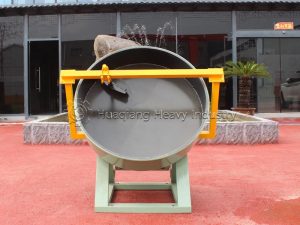
Turning to the field of organic fertilizer production, the bio disk organic fertilizer machine is the core granulation equipment in the organic fertilizer granulation production line. The working principle of this equipment is based on the combined action of centrifugal force and friction—the material is placed in an inclined rotating disk. Under the centrifugal force generated by the disk’s rotation, the material continuously rolls along the disk surface and adheres to each other, gradually agglomerating into spherical granules. The significant advantages of the disc granulator are its short process route, simple structure, low investment, and intuitive operation. Its granulation disc adopts an integral arc structure design, achieving a granulation rate of over 93%. The tilt angle of the disc is typically adjustable between 45 and 55 degrees. By adjusting the tilt angle and rotation speed, the size and uniformity of the particles can be precisely controlled. This equipment is highly adaptable to raw materials, suitable not only for organic waste such as livestock and poultry manure, distiller’s grains, papermaking sludge, and municipal sludge, but also for the low-temperature granulation of various materials such as bio-fertilizers and organic-inorganic compound fertilizers. In a complete bio-organic fertilizer production line, the bio-disk organic fertilizer machine is usually located after pretreatment processes such as fermentation and crushing. It transforms the fermented, decomposed, and crushed organic materials into uniform spherical particles, which are then further processed through drying, cooling, screening, coating, and automatic packaging to complete the finished product production. The entire production line can be flexibly configured according to capacity requirements, with mature complete solutions available for annual production from 10,000 tons to 200,000 tons.
Whether it’s an NPK blended fertilizer production line or a bio-organic fertilizer disc granulation production line, the underlying logic is: precise ingredient control, efficient mixing or granulation processes, and fully automated workflow integration. As a professional manufacturer of fertilizer production equipment, we provide not only single pieces of equipment, but also a one-stop solution from process design, equipment manufacturing, installation and commissioning to production operation and maintenance.