
【FAQ】Can granules produced by a disc granulator be directly blended?
Many organic fertilizer plants, after producing organic granules using a disc granulator, wish to expand their product lines by blending these organic granules with chemical fertilizer granules to create organic-inorganic compound fertilizers or BB (Bulk Blending) fertilizers. However, directly feeding organic granules from a disc granulator into an NPK blending line often leads to issues such as segregation, caking, and uneven nutrient distribution. Successful blending depends on the physical compatibility of the granules and the design of the production line integration.
Particle size matching is a prerequisite for blending. BB fertilizer production imposes strict requirements on raw material particle sizes; the size difference between components should be controlled within ±0.5 mm. By adjusting the disc inclination angle (35°–55°) and rotation speed (11–20 r/min), a disc granulator can control organic granule sizes within the 2–4 mm range. However, improper operation can result in a significant number of oversized granules (>5 mm) and fine powder (<1 mm). These substandard materials must be removed via screening; otherwise, entering the blender with such large size disparities causes segregation—where fine powder settles at the bottom and large granules float to the top—leading to uneven nutrient distribution within the packaging.
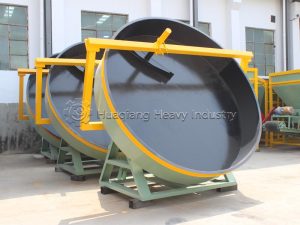
Moisture content and granule strength determine storage stability after blending. Disc granulation is a wet process; post-granulation granules typically have a moisture content of 25%–35%. A drying system is essential to reduce moisture to below 5% before mixing with chemical fertilizer granules like urea or ammonium phosphate. If moisture levels remain high, organic granules tend to absorb moisture and cake upon contact with chemical fertilizers, causing the entire batch to harden into solid lumps during storage. Additionally, the compressive strength of the organic granules must be ≥10 N; otherwise, they may break or pulverize during the blending process, increasing the rate of material recycling. Granules produced by the double-roller press granulator exhibit higher strength (≥30 N) and lower moisture content (8%–15%), making them highly suitable as direct raw materials for BB (Bulk Blending) fertilizer.
Key design considerations for production line integration. If the output from a disc granulation line is intended for use as a raw material for BB fertilizer, an intermediate buffer silo and an online moisture analyzer should be installed between the two lines to ensure stable moisture levels and particle sizes before the organic granules enter the mixer. The batching system of the NPK blending fertilizer line requires a dedicated dosing silo and electronic scale for the organic granules to precisely control their proportion in the total formula (typically 5%–30%). A twin-shaft paddle mixer is recommended for the mixing stage to ensure superior mixing uniformity between organic and inorganic granules.
New options for equipment integration. A new type of “two-in-one” organic fertilizer granulator integrates mixing and granulation functions; it produces more uniform granules with lower rates of pulverization and allows for direct connection to subsequent blending processes, thereby reducing intermediate handling steps. Strategically combining disc granulation (or extrusion granulation) with a BB fertilizer line enables the flexible production of differentiated products—such as organic-inorganic compound fertilizers and bio-organic blended fertilizers—thereby enhancing market competitiveness.