Measures to Prevent Material Segregation in NPK Blending Fertilizer Production Lines
The most common problem in NPK blending fertilizer production lines is product stratification and segregation, resulting in uneven nutrient distribution and significant content deviations after loading, unloading, and transportation. The core reason is the large differences in particle size, specific gravity, and roundness of the raw materials. Control must be maintained throughout the entire process, from batching, mixing, conveying, to packaging.
First, control the source of raw materials. Use nitrogen, phosphorus, and potassium raw materials with similar particle sizes and specific gravities. Significant differences in particle size and weight easily lead to natural stratification after mixing. Clumped raw materials should be crushed and screened beforehand to ensure uniform particle size and reduce segregation conditions at the source.
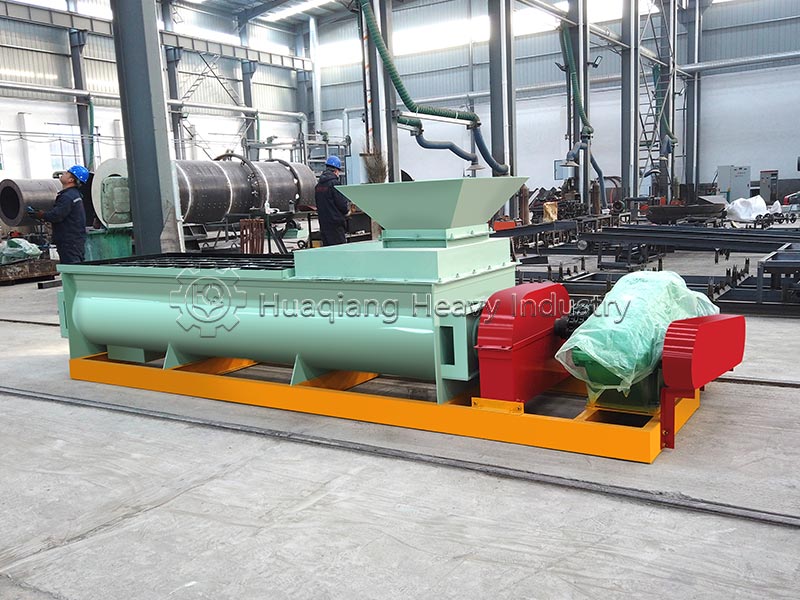
Second, optimize the mixing process. Use a double axis mixer to ensure sufficient mixing time and thorough mixing before discharging. Avoid short, perfunctory mixing. Avoid excessive tumbling and agitation during mixing to prevent lighter materials from floating and heavier materials from sinking.
Finally, improve the conveying and unloading process, as this is where stratification is most severe. The greater the drop height of the material, the more severe the stratification. To prevent this, the drop height should be reduced, and buffer and diversion devices should be installed at the discharge port to slow down the material and prevent it from falling freely from a height. The belt conveyor speed should be stable to avoid excessive speed and vibration that can cause separation of coarse and fine particles.
Furthermore, packaging and storage should be controlled. The process from discharge to packaging silos should be shortened as much as possible, and diversion devices should be installed inside the silos to prevent material segregation and accumulation. During packaging, the material should be discharged at a uniform speed to reduce impact and tumbling. Finished products should not be stacked too high, and handling and loading should minimize repeated throwing, tipping, and vibration, as greater vibration exacerbates stratification.
Finally, maintaining a stable formula and ensuring that the specifications of raw materials from different batches are as uniform as possible, avoiding frequent changes in granule form, and adhering to standardized operating procedures throughout the entire process will significantly reduce stratification in blended fertilizer materials.