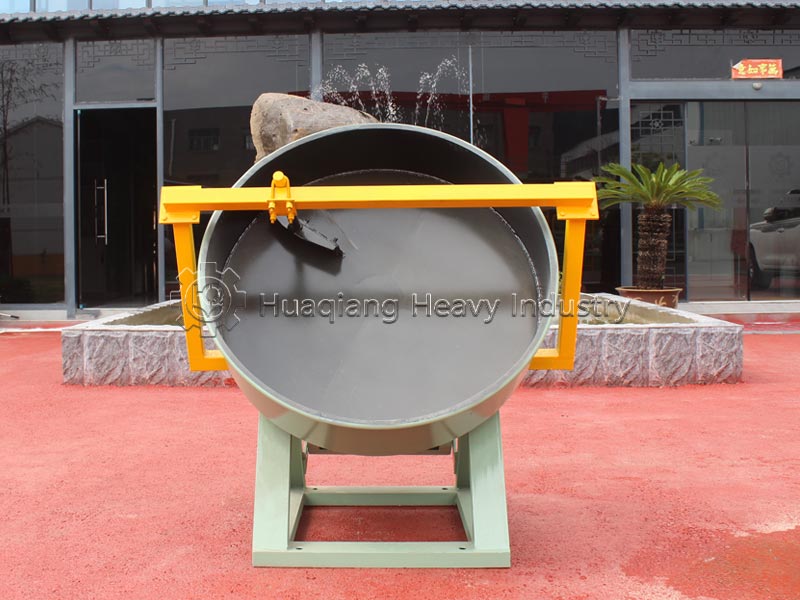
Granulation Process for Disc Granulation Production Lines
The granulation process employed in disc granulation production lines is mature, stable, and easy to operate, producing granules of uniform size; it is a widely utilized granulation method in the production of organic and compound fertilizers. The complete process primarily comprises the following stages: batching, mixing, disc granulation, screening, drying, cooling, and finished product packaging.
First, various raw materials are precisely weighed according to a specific formula using a batching system and then fed into a horizontal fertilizer mixer for thorough and uniform blending, ensuring compositional consistency and preventing agglomeration. The blended material is subsequently conveyed to a disc granulator. As the disc rotates, an atomizing device uniformly sprays an appropriate amount of water or binder onto the material, causing the fine powder particles to adhere to one another and agglomerate, thereby gradually forming small granule nuclei. These small granules continuously roll, collide, and undergo a rounding process within the rotating disc, gradually growing in size to form granules that are uniform in dimension and highly spherical in shape.
Upon completion of the granulation stage, the wet granules are discharged from the disc and undergo preliminary screening. Oversized granules and fine powders that do not meet the specifications are returned to the mixer or the granulator for reprocessing. The qualified wet granules then enter a dryer, where hot air is applied to remove excess moisture, thereby enhancing granule strength and resistance to breakage. The dried granules are then transferred to a cooler to reduce their temperature, preventing them from softening or caking due to excessive heat. The cooled finished granules undergo a final screening to ensure uniform particle size and compliance with quality standards, after which they are automatically weighed and packaged by a packaging machine.
The entire process flow is continuous, seamless, and highly automated; it features a high granulation rate, produces granules that are round, smooth, and structurally robust, and offers stable operation with convenient maintenance—making it ideally suited for the large-scale production of various types of fertilizers.