
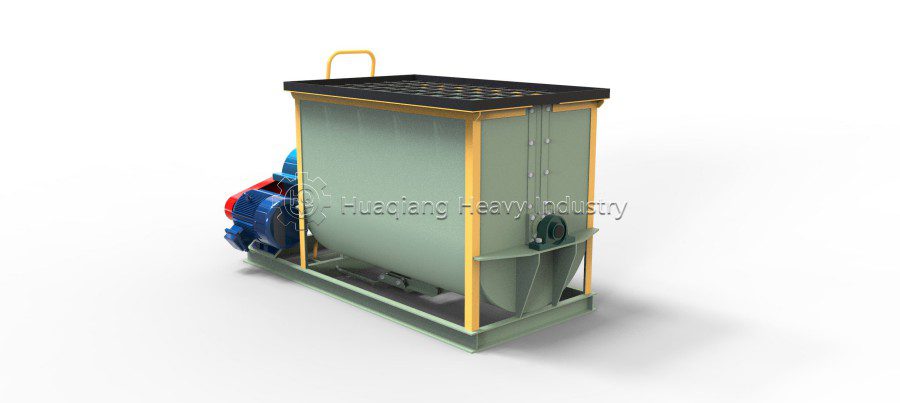
Horizontal mixers can be categorized into various types based on their mixing structures, such as ribbon, plow-share, and zero-gravity models. The ribbon mixer is the most common type, consisting of a U-shaped vessel, ribbon-style mixing blades, and a drive assembly. The horizontal ribbon mixer is a modern mixing device characterized by high efficiency, superior mixing uniformity, a high loading coefficient, low energy consumption, and minimal material degradation. Its unique double-ribbon design enables rapid and uniform material blending. It offers broad applicability, handling not only powder-to-powder mixing but also powder-to-liquid blending, as well as the processing of pastes, viscous substances, and high-density materials.
The core technological evolution of horizontal mixers centers on achieving high-efficiency mixing, low energy consumption, and broad versatility. Advancements have been continuous—ranging from initial single-layer ribbon designs to double- and triple-layer configurations, from standard drives to variable-frequency speed control, and from manual discharge to pneumatic full-opening discharge mechanisms. Widely utilized in industries such as fertilizers, chemicals, food processing, and pharmaceuticals, the horizontal mixer has become an indispensable piece of core equipment in the field of powder mixing.
The technical architecture of horizontal mixers can be categorized into the following types:
Ribbon Mixer: Composed of a U-shaped vessel, ribbon-style mixing blades, and drive components. The ribbon blades typically feature a double- or triple-layer design; the outer helix gathers material from both ends toward the center, while the inner helix conveys material from the center toward both ends. It is suitable for mixing powder-with-powder and powder-with-liquid combinations. This is a new type of mixing equipment characterized by high efficiency, high uniformity, a high loading coefficient, low energy consumption, low pollution, and minimal material breakage.
Ploughshare Mixer: A new type of high-efficiency powder mixing equipment. It is applicable to solid-solid and solid-liquid mixing, as well as composite processes such as wet granulation, drying, and concentration.
Gravity-free Mixer: Features a horizontal cylindrical body equipped with dual shafts rotating in opposite directions, fitted with angled paddles that circulate and agitate the material both axially and radially. The rotational speed driven by the gearbox and the specific configuration of the paddles reduce the effective gravity acting on the material; consequently, significant disparities in particle size and specific gravity among the materials become negligible during the mixing process.
Horizontal mixers are suitable for a wide range of industries. Fertilizer industry: mixing of organic, compound, and blended fertilizers. Chemical industry: mixing of fine chemicals, plastics, rubber, and coatings. Food and pharmaceutical industries: mixing of food products, pharmaceuticals, and cosmetics. Feed industry: mixing of animal feed and feed additives. Construction materials industry: mixing of thermal insulation mortar, putty, and gypsum.
Horizontal mixers offer exceptional adaptability to various materials. Material forms include powders, granules, pastes, viscous substances, and high-density materials. Mixing types cover solid-solid (powder-to-powder) and solid-slurry (powder-to-paste/slurry) combinations. The equipment handles material particle sizes ranging from 20 to 1400 mesh. Regarding material characteristics, excellent mixing results are achieved even when there are differences in specific gravity or particle size.