
The “Hidden Cost” of Granule Shape: Agronomic Compatibility—From Disc Granulation to Extrusion Granulation
When applying fertilizer in the field, farmers often focus solely on nutrient content while overlooking a variable that directly impacts application efficiency: granule shape. Spherical granules offer excellent flowability, allowing them to pass smoothly through the pipes of pneumatic spreaders; conversely, while irregular granules may possess high structural strength, they are prone to jamming machinery. This seemingly minor difference underpins two vastly different granulation process pathways.
The organic fertilizer disc granulator is the quintessential piece of equipment for producing spherical granules. Its core component is an inclined, rotating disc; powdered organic material is continuously fed from above while a fine mist of water is sprayed onto it. Driven by the combined forces of centrifugal action, friction, and gravity, the material tumbles along a parabolic trajectory, with fine particles accumulating layers—much like a rolling snowball—to gradually increase in size. The disc’s inclination angle is typically adjustable between 35 and 55 degrees, and its rotational speed is inversely proportional to its diameter. Granules produced via this wet granulation process are smooth and uniform, achieving a sphericity of over 90%—making them ideal for organic fertilizer products that demand high flowability. However, there is a clear trade-off: the granules have a high moisture content (ranging from 20% to 35%) and require drying and cooling before they can be bagged and stored.
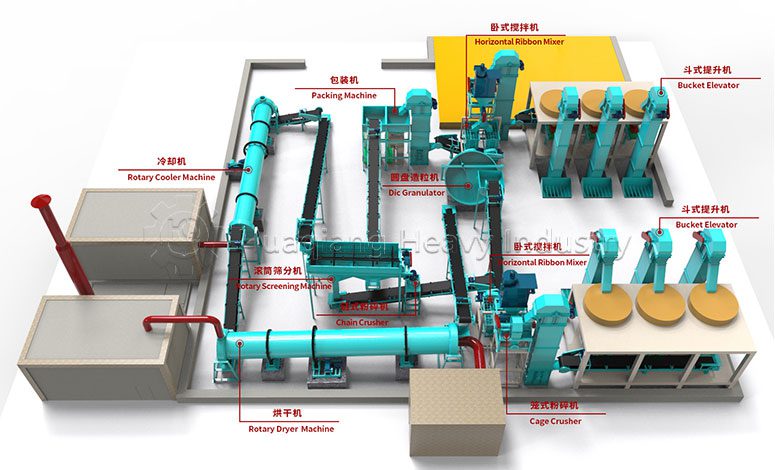
A single disc granulator is merely the starting point; the disc granulation production line represents a comprehensive solution. This line integrates granulation, drying, cooling, screening, and packaging into a continuous workflow. Wet granules from the disc first enter a rotary dryer, where they slowly dehydrate in a stream of hot air (60–80°C) until their moisture content drops below 5%. They then pass through a cooler to reach room temperature, preventing residual heat from causing condensation inside the packaging bags. Finally, a screening stage separates the product: oversized granules are crushed and recycled, while undersized fines are returned for re-granulation, ensuring a consistent final particle size. The true value of the entire line lies in stability—moisture content, particle size distribution, and sphericity are tightly controlled for every batch, ensuring consistency in every bag of fertilizer purchased by farmers.
Roller press granulation production lines take a different approach. Instead of relying on moisture or heat, they use two counter-rotating, high-strength rollers to compress dry powder directly into sheets under pressures of several hundred megapascals; these sheets are subsequently crushed and screened into granules. While extrusion-granulated particles are irregular in shape and feature surface indentations—resulting in lower sphericity compared to pan-granulated products—they offer high density and strength, making them resistant to crumbling during storage and transport. Crucially, this production method eliminates the need for drying and cooling stages, reducing overall energy consumption by 30% to 50%. For formulations with high urea content that are prone to deliquescence (absorbing moisture from the air), extrusion is often the only viable forming method.
The choice between pan granulation and extrusion essentially comes down to a trade-off between sphericity and energy consumption. Pneumatic fertilizer spreaders require spherical granules with good flowability, giving pan granulation the advantage; conversely, in scenarios where cost control is paramount and raw materials are primarily powdered, the dry-process route of extrusion granulation is more pragmatic. Particle shape is far from a trivial detail; it directly determines how smoothly the fertilizer travels from the factory to the field.