
【FAQ】BB fertilizer production lines offer immediate results, while bio-organic fertilizer production lines require gradual accumulation – which path to choose?
Both involve investing in a fertilizer production line, but the NPK blending fertilizer production line prioritizes speed, while the bio-organic fertilizer disc granulation production line prioritizes flexibility. Two sets of equipment, two different logics, corresponding to completely different market positioning and business rhythms.
The NPK blending fertilizer production line solves the problem of precision. Nitrogen, phosphorus, and potassium are the “staple foods” of crops. Urea, ammonium phosphate, potassium chloride, and other granular raw materials are mixed by the dual-shaft paddle mixer of the NPK blender, producing a precisely proportioned finished product within 2-5 minutes. The core of the entire NPK blending production line is an automated closed loop of “storage – metering – conveying – mixing – packaging,” with a PLC control system supporting rapid switching between multiple formulas. From equipment to factory to normal mass production, it typically takes only about ten days. Low investment, quick results, and flexible formulas make it the first choice for agricultural input dealers transitioning to branded fertilizers. The bio-organic fertilizer disc granulation production line addresses the issue of “activity.” The core of bio-organic fertilizer is beneficial functional bacteria (such as Bacillus subtilis), which are sensitive to high temperatures—the survival rate drops drastically above 60℃. The bio-organic fertilizer disc granulator uses an inclined rotating disc structure. The material naturally rolls into spheres on the disc surface using its own viscosity and a small amount of water. The temperature throughout the process does not exceed 55℃, and the survival rate of functional bacteria can reach over 80%. The disc inclination angle is adjustable, and the rotation speed is typically controlled at 11-15 r/min. However, bio-organic fertilizer production lines require pre-treatment processes such as fermentation and composting, and the commissioning period from equipment installation to normal mass production often takes several months. The investment recovery period is longer, but the added value of the product is higher.
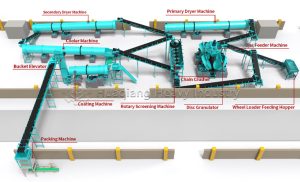
The difference between the two production lines is essentially a difference in two business logics. The BB fertilizer production line operates on a “fast business”—raw materials are purchased and used immediately, equipment is installed and production begins, and payment is received within days. Bio-organic fertilizer production lines operate on a “slow business”—raw materials need fermentation and maturation, microbial strains need propagation and activation, and the market needs education and cultivation; each step is far more complex than that of BB fertilizer production lines. The former is suitable for investors with limited funds who want to enter the market quickly; the latter is suitable for long-term investors with organic raw material resources who are targeting the high-end market. Neither path is inherently better or worse; it’s simply a matter of whether it matches your resources, goals, and patience.