
【FQA】The design logic of a production line determines its longevity.
The selection of fertilizer production equipment is never a competition of individual machine performance, but rather the system’s ability to respond to “stability.” Equipment can be replaced at any time, but once the design logic of a production line is finalized, it will continuously affect product quality and production costs for the next five to ten years. The following analyzes the underlying logic of production line design from three core aspects: batching, mixing, and granulation.
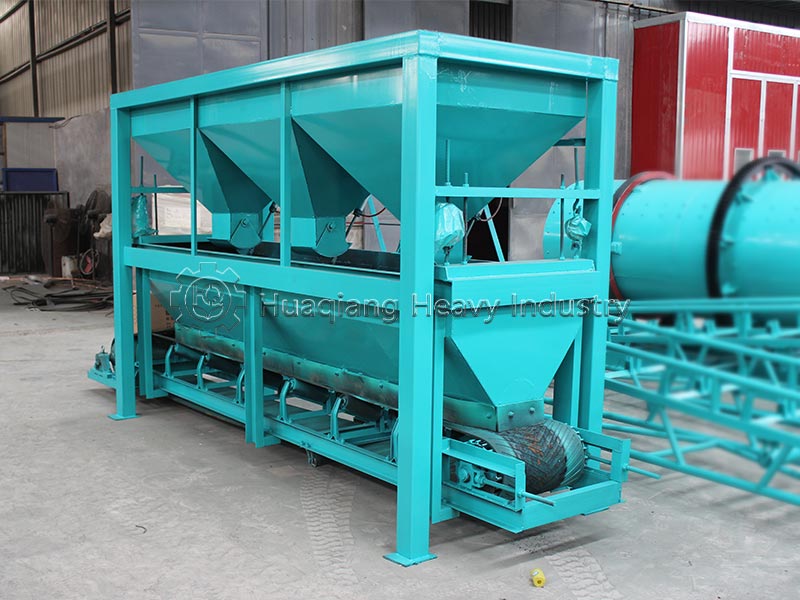
The design of the batching system determines the accuracy of the formulation. A multiple silos single-weigh static batching system uses a single set of high-precision weighing sensors. Raw materials from each silo are sequentially fed into the same weighing hopper, weighed one by one, and then transported together. Each batch of raw material is weighed in a completely static state, unaffected by factors such as conveyor belt speed and material flow fluctuations. The static batching error can be controlled within ±0.2%. The core of this design logic is “stop-and-weigh for accuracy”—it sacrifices the speed of continuous production for batch precision. For a production line with an annual output of tens of thousands of tons, a 0.2% difference in precision means whether the nutrient content of hundreds of tons of product each year falls within the national standard range. However, if the pneumatic gate of the batching system malfunctions or the sensors are interfered with, the precision advantage of static batching will be lost.
The design of the mixing equipment determines the upper limit of uniformity. The NPK blending machine (npk blending machine / npk bulk blending machine) adopts a twin-shaft paddle structure, with two stirring shafts rotating in opposite directions, causing the material to undergo three-dimensional tumbling motion within the mixing chamber. The BB fertilizer mixer’s mixing process is gentle and efficient, completing a single batch in 2-5 minutes, with a coefficient of variation (CV) of ≤5% for mixing uniformity and a particle breakage rate <0.5%. The core of this design logic is “flexible uniformity”—the force cannot be too great (otherwise particle breakage and pulverization will increase), nor too small (otherwise mixing will be insufficient). The equipment has a wide mixing time window (3-8 minutes), which operators can flexibly adjust according to different formulations. Even the best-designed mixer cannot solve the segregation problem caused by mismatched raw material particle sizes—a constraint that must be considered during the production line design phase.
The design of the bio-organic fertilizer production line determines the survival of the microorganisms. The bio-disk organic fertilizer machine uses a room-temperature physical molding process, where materials roll on the disc to form spheres, with the temperature not exceeding 55℃ throughout the process. The survival rate of functional bacteria can reach over 80%, significantly better than traditional high-temperature granulation equipment (survival rate of only 30%-50%). However, if the production line design incorporates a high-temperature drying process after granulation—with inlet air temperatures exceeding 80℃ and outlet temperatures exceeding 60℃—all previous efforts are wasted. The configuration logic of bio-organic fertilizer equipment must be based on the principle of “low-temperature granulation, room-temperature molding,” with each piece of equipment serving to “preserve the activity of the microorganisms.”