
【FAQ】What are the challenges of a production line that simultaneously performs blending and granulation?
In fertilizer production, blending (BB fertilizer) and granulation (extrusion or disc) are often considered two independent processes. Many factories choose to do only one, believing they are incompatible. However, in reality, a single pretreatment system can serve both production lines simultaneously; the key is understanding the fundamental differences between the three processes.
The core of a BB fertilizer production line is “accurate mixing and uniform blending.” The NPK blending machine (npk blending machine / npk bulk blending machine) uses a twin-shaft paddle wheel structure to uniformly mix granular raw materials such as urea, ammonium phosphate, and potassium chloride within 2-5 minutes, with a uniformity coefficient of variation (CV) ≤ 5%. However, the biggest obstacle to this production line is particle segregation—urea (bulk density approximately 1.33 g/cm³) and potassium chloride (approximately 1.98 g/cm³) have a density difference of nearly 50%, and will spontaneously separate during transportation and packaging after mixing. The key to preventing segregation lies not in the mixing stage, but in source control—the particle size of all raw materials must be matched, with differences controlled within ±0.5 mm. The batching process relies on a multiple silos single-weigh static batching system to statically weigh each raw material one by one, with errors controlled within ±0.2%.
The logic of the roller press granulator line is completely different. Powdered materials are extruded into flakes under high pressure by two rollers, and then crushed and screened into granules. The entire roller press granulator production line requires no water addition or drying, making it suitable for dry powder materials with a moisture content of 8%-15%. It solves a problem that BB fertilizer cannot—turning powdered materials into granules with high strength, suitable for long-distance transportation. However, extrusion granulation requires extremely high raw material fineness (≥60 mesh), and roller wear is the biggest operating cost.
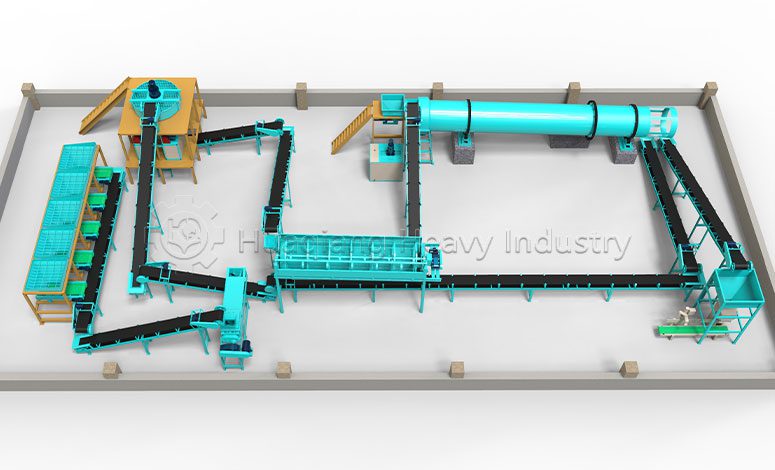
Bio-organic fertilizer disc granulation, on the other hand, prioritizes the survival of the raw materials. The bio-organic fertilizer disc granulator uses a room-temperature physical molding process, where materials roll on the disc to form spheres, with the temperature not exceeding 55℃ throughout the process, resulting in a functional bacteria survival rate of over 80%. The sphere formation rate can reach 85%-95%. However, it has strict requirements on the moisture content (25%-35%) and fineness (1.5-3mm) of the incoming materials.
The feasibility of sharing a pretreatment system across the three processes lies in the fact that raw material storage, crushing, batching, and mixing are completely identical across the three production lines. If a production line is configured with three process routes simultaneously, the front-end raw material processing system can be shared. A single pretreatment system shared by all three production lines allows for flexible product switching within the same plant area based on market demand—producing BB fertilizer today, extruded granules tomorrow, and bio-organic granules the day after.