
NPK Blending Line vs. Bio-disc Granulator: Choosing Between Two Technological Paths in Fertilizer Production
In fertilizer production equipment selection, NPK blenders, NPK bulk blenders, and NPK blending production lines represent a completely different manufacturing philosophy from bio-organic fertilizer disc granulators. One focuses on the precise mixing of pre-granulated materials, while the other constructs granules from powder. Understanding this difference is key to making the right equipment investment decisions.
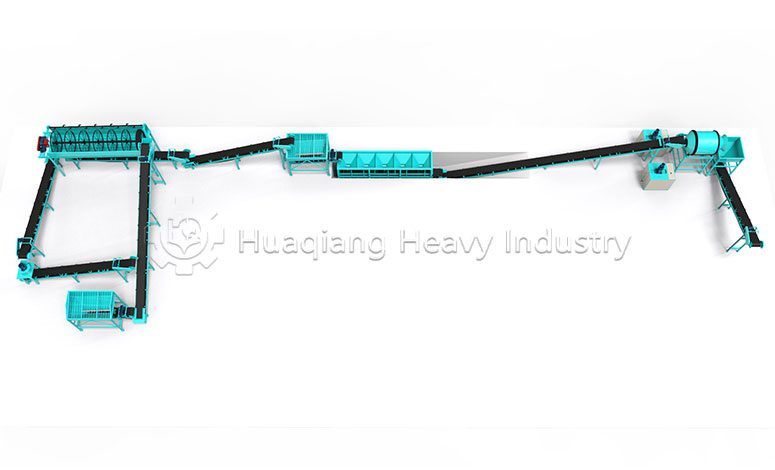
NPK Blending Production Line: Precise Physical Mixing
NPK blending production lines—often called BB fertilizer (blended fertilizer) production lines—are designed for physical mixing, not chemical reactions or granulation. This process directly blends pre-granulated single-element base fertilizers—large-particle urea, monoammonium phosphate, potassium sulfate, etc.—in precise proportions according to specific crop and soil requirements, without involving any chemical reactions throughout the process.
A complete NPK blending production line consists of four main modules connected in series: a raw material storage and conveying system, a high-precision batching and metering system, mixing equipment, and an automatic packaging machine. During production, electronic scales weigh each raw material according to a preset formula, with measurement errors controlled within a minimal range. The weighed materials then enter an NPK mixer for uniform mixing, followed by automatic packaging.
Bio-organic fertilizer disc granulator: Building granules from powder
The bio-organic fertilizer disc granulator (also called a disc granulator or pelletizing disc) serves a completely different purpose. Instead of mixing pre-formed granules, it uses a wet granulation process to build spherical granules from powdered materials.
The equipment consists of a tilted circular disc fixed to a sturdy base. Powdered organic material—such as well-rotted chicken manure, cow manure, or crop straw—is fed into the rotating disc. As the disc rotates, centrifugal force, friction, and gravity work together to tumble the material. A built-in water spray system sprays a fine mist, causing the granules to adhere to each other and grow layer by layer—like a snowball. When the granules reach the target diameter (typically 3 to 5 millimeters), they naturally overflow from the edge of the disc. The bio-organic fertilizer disc granulator achieves a granulation rate of over 93%. The disc body features an integral arc structure lined with high-strength fiberglass, making it corrosion-resistant and wear-resistant. The adjustable tilt angle allows operators to flexibly control particle size.
Key Difference: Temperature Sensitivity
The most important difference between these two types of equipment lies in temperature control. NPK blending is a purely physical mixing process—it generates and requires no heat. The bio-organic fertilizer disc granulator operates at room temperature, which is crucial for bio-organic fertilizer production. Beneficial microorganisms—the functional core of bio-organic fertilizer—die in environments exceeding 60°C. Because disc granulation is a purely physical rolling process, requiring no heating throughout, these microorganisms survive intact during granulation. This makes the bio-organic fertilizer disc granulator the preferred solution for producers who need to preserve the bioactivity of the finished product.
How to Choose?
The choice between an NPK blending production line and a bio-organic fertilizer disc granulator depends entirely on the form of the raw materials and the target product. If you are purchasing pre-granulated single-element fertilizers and your goal is to produce customized blended fertilizer formulations, the NPK blending production line offers a path with the lowest investment and fastest start-up. If you have powdered organic waste and need to produce spherical pellets—especially bio-organic fertilizers containing active microorganisms—a bio-organic fertilizer disc granulator is an indispensable core piece of equipment. Understanding this fundamental difference is the first step in making informed equipment investment decisions.