
【FAQ】Why isn’t the dissolution rate of fertilizer granules determined solely by the granulator itself?
The rate at which fertilizer granules dissolve upon contact with water directly affects nutrient release and application methods. Fast-acting fertilizers require rapid disintegration and quick nutrient release, whereas slow-release fertilizers aim for gradual dissolution to extend the nutrient supply period. However, the dissolution rate is not governed by a single granulator parameter; rather, it is determined by a combination of raw material characteristics, the forming method, granule porosity, and post-processing techniques.
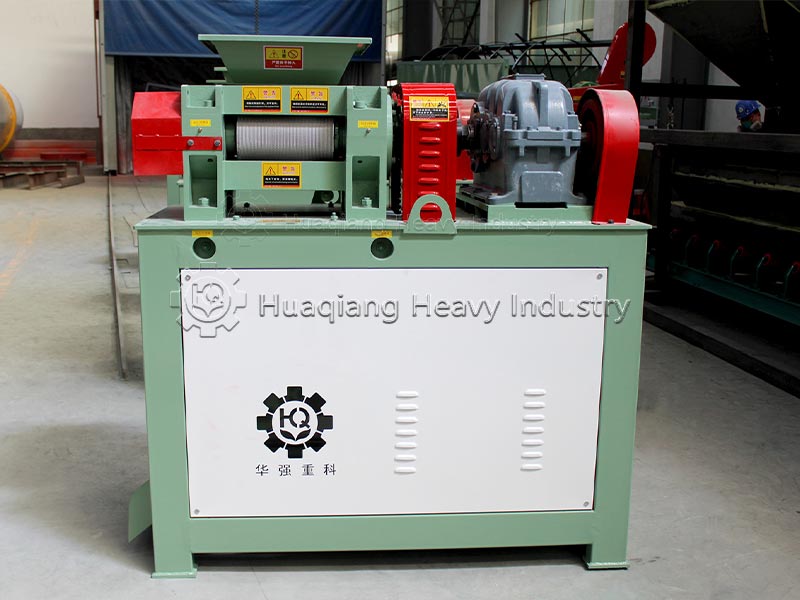
Double-roller extrusion granulation: High-pressure compaction leads to slow dissolution. Double roller press granulators (and fertilizer roller press machines) use a pair of counter-rotating rollers to compress powdered material into dense sheets under high pressure, which are subsequently crushed and screened into granules. This forming method results in very low internal porosity, making it difficult for moisture to penetrate quickly and naturally slowing the dissolution rate. The core of double-roller press granulation technology lies in using high pressure to increase granule density, making the product suitable for use as a base fertilizer with steady, long-lasting nutrient release. However, if precise controlled-release effects are required, subsequent coating treatment is still necessary.
Disc granulation: Wet agglomeration leads to rapid dissolution. New type two-in-one organic fertilizer granulators (and similar organic fertilizer granulators) employ wet agglomeration, where materials roll into spheres on an inclined disc surface using their own moisture content. The resulting granules retain numerous micropores, allowing for rapid moisture penetration and quick disintegration upon contact with water; this results in fast nutrient release, making them suitable for use as top-dressing fertilizers. However, high porosity also implies lower compressive strength, posing a higher risk of powdering during long-distance transport. In the context of bio-organic fertilizer granulation, porosity holds special significance: moderate porosity facilitates the entry of oxygen and moisture, providing a more stable micro-environment for functional bacteria. Nevertheless, the temperature throughout the granulation process must be kept below 55°C to prevent massive die-off of the bacterial strains.
BB Fertilizer: No granulation involved; original granule dissolution characteristics are preserved. BB fertilizer production lines and mixers utilize a purely physical blending process that preserves the original shape of the granules. Consequently, the dissolution characteristics of raw materials—such as urea, ammonium phosphate, and potassium chloride—are retained in the final product. The core of the BB fertilizer mixing process is “shape-preserving blending”; it employs a twin-shaft paddle mixer for gentle agitation, completing the cycle in 2 to 5 minutes with a coefficient of variation (CV) for uniformity of ≤5% and a granule breakage rate kept below 0.5%. The nutrient accuracy of the entire line relies on a multi-silo, single-scale static batching system: raw materials are discharged sequentially into a single weigh hopper for individual static weighing before being conveyed together, allowing the batching error to be controlled within ±0.2%.
Dissolution rate is a matter of product positioning rather than an issue with any single piece of equipment. Before selecting a production line, one must determine whether the product requires rapid availability or slow release, and whether it is intended for basal application or top-dressing. For rapid availability, choose disc granulation; for steady release, opt for roller compaction; for formulation flexibility, select BB fertilizer blending; and for bio-organic fertilizer production, strictly control temperature limits throughout the granulation and drying stages.