
Process Synergy and Application Boundaries: BB Fertilizer Blending Lines vs. Disc Granulators
In the fertilizer production sector, BB (Bulk Blending) fertilizer blending lines and organic fertilizer disc granulators represent two distinct process philosophies. The former relies on the precise physical blending of pre-granulated materials according to a specific formula, whereas the latter transforms powdered raw materials into spherical granules through a wet rolling process. Neither is inherently superior to the other; the choice depends on differences in raw material forms and production objectives. Understanding the operational boundaries and potential synergies of these two technical pathways is essential for fertilizer manufacturers making informed equipment investment decisions.
The core value of a BB fertilizer blending line lies in its streamlined process. BB fertilizer production is essentially a purely physical process: pre-granulated basic fertilizers—such as granular urea, monoammonium phosphate (MAP), and potassium sulfate—are blended directly based on soil-test-derived formulas. The production line comprises four main modules: raw material storage and conveying, dynamic batching and metering, the NPK blender, and the automatic packaging system. The batching system utilizes computer control to perform dynamic, cumulative metering based on formula setpoints, keeping measurement errors within ±0.2%. Materials then enter the NPK blender, which employs a twin-shaft paddle or “zero-gravity” mixing structure; specially angled paddles ensure rapid, uniform mixing within 30 to 90 seconds. The NPK blender is specifically optimized to address common industry challenges—such as the tendency of granules with varying densities and sizes to stratify or segregate during mixing—by utilizing a unique internal spiral mechanism and a distinct 3D structure for material agitation and discharge. The entire line eliminates the need for complex granulation, drying, and cooling stages, requiring a footprint of only 60 to 100 square meters and offering energy savings of over 60% compared to traditional compound fertilizer lines. For enterprises needing to respond quickly to seasonal fertilizer demand—such as agricultural distributors transitioning to branded fertilizers or large-scale plantations establishing their own blending stations—BB fertilizer blending lines offer low investment costs, rapid returns, and flexible formula switching. They serve as highly efficient equipment for closing the loop across soil testing, formula development, production, and application.
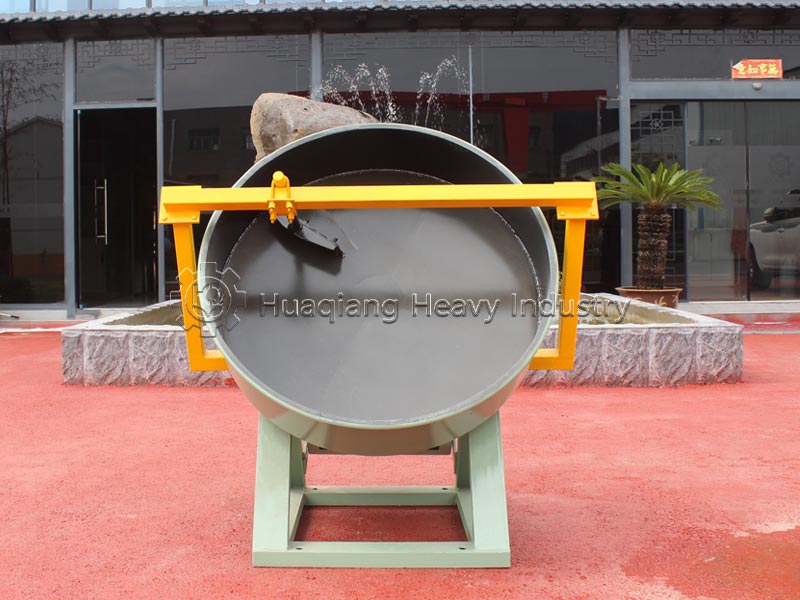
When raw materials in powder form need to be converted into granular products, the organic fertilizer disc granulator serves as the core granulation equipment. The machine’s primary working component is a circular disc mounted at an incline, with an angle typically adjustable between 35° and 55°. Powdered material is fed onto the rotating disc; under the combined influence of centrifugal force, friction, and gravity, the material moves along a parabolic trajectory, adhering and rolling together to grow into spherical granules before eventually spilling over the disc’s edge. The granulator features an integrated arc-shaped structure, achieving a granulation rate of over 93%. The disc bottom is reinforced with multiple radial steel plates, ensuring durability and resistance to deformation. The interior is lined with high-strength fiberglass (FRP) for corrosion and wear resistance. Both the disc inclination and rotation speed can be adjusted as needed, offering a wide range of particle size control and strong process adaptability. Unlike the dry forming method used in double-roller extrusion granulation, disc granulation is a wet rolling process that requires the controlled addition of moisture or binders via an internal spraying system. Its standout advantage is ambient-temperature operation: the entire pelletizing process requires no heat, meaning functional microbial strains added during granulation remain active rather than being destroyed by high temperatures, thereby fully preserving the viability of microorganisms in the finished granules. This characteristic gives the organic fertilizer disc granulator an irreplaceable role in the production of bio-organic fertilizers.