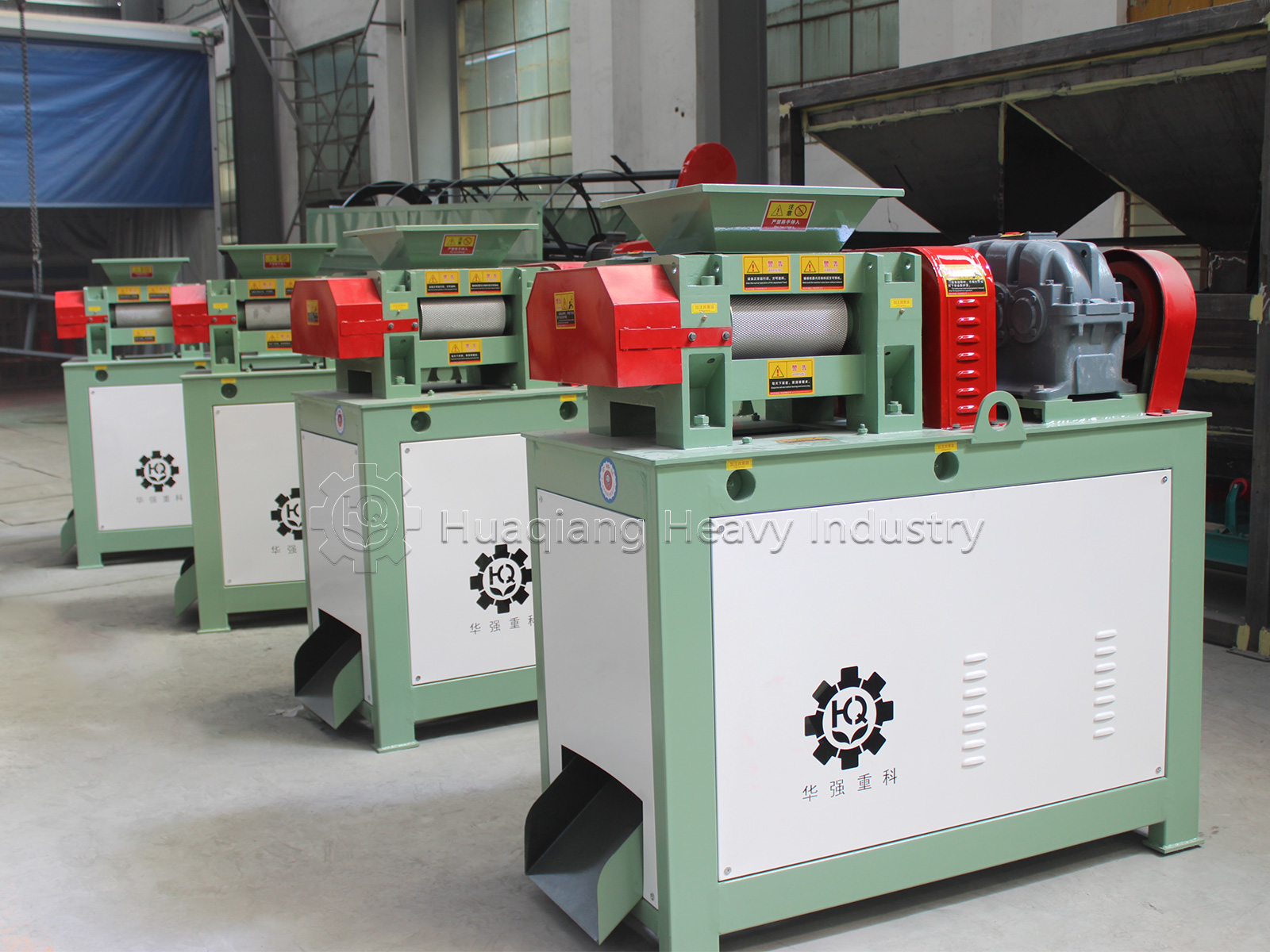
Core Advantages of Roller Press granulator Production Lines
The double roller press granulator process is currently the mainstream technology for large-scale production of bio-organic fertilizers. Compared with traditional disc granulation, its biggest advantages are dry forming, no drying required, large capacity, low cost, and high microbial survival rate, making it very suitable for stable mass production in small, medium, and large organic fertilizer plants.
First, dry forming and short process flow. Extrusion granulation requires no water or binders, relying on the organic matter of the material itself for extrusion forming. It eliminates the drying and high-temperature cooling processes necessary for disc granulation, significantly shortening the production line flow, reducing equipment investment and plant footprint. Roller press granulator production lines are faster to start and simpler to operate and maintain.
Second, low temperature throughout the process, protecting the activity of beneficial bacteria. The process has no high-temperature heating process, avoiding the inactivation of beneficial bacteria at high temperatures. The number of live bacteria in the finished product is stable, fully complying with national standards for bio-organic fertilizers. Product quality is more controllable than with wet granulation.
Third, high finished product hardness, not prone to clumping, and good storage resistance. Extruded granules have a dense structure, high strength, and low dust content, making them less prone to breakage during transportation and handling, less prone to caking during stacking, resulting in longer storage periods, stable appearance, and higher market acceptance.
Fifth, they offer high capacity, low energy consumption, and stable operation. Extrusion equipment operates continuously with a low failure rate and output far exceeding that of disc granulation, making it suFertilizer manufacturingitable for 24-hour continuous production. It also boasts lower labor and electricity costs, resulting in higher overall production efficiency, making it the preferred molding equipment for large-scale organic fertilizer plants.