
【FAQ】Which is harder to remedy: particle segregation or microbial inactivation?
BB fertilizer production lines and bio-organic fertilizer disc granulation lines represent two extreme pursuits in fertilizer production—the former strives for perfect physical uniformity, while the latter pursues biological activity that results in “living” products. The underlying logic of these two production lines is completely different, yet they are often discussed as the same thing.
The enemy of the BB fertilizer production line is “invisible segregation.” The core value of the NPK Blending Fertilizer Production Line lies in its flexible formulation—switching from 15-15-15 to 28-6-6 can be completed within minutes by simply selecting the formulation number on the PLC control panel. However, the most hidden problem of this production line is not equipment failure, but particle segregation. Urea (bulk density approximately 1.33 g/cm³) and potassium chloride (approximately 1.98 g/cm³) have a density difference of nearly 50%. Even if an NPK blending machine is used to mix them evenly, heavier particles will still sink to the bottom and lighter particles will float during subsequent transportation and packaging. When the finished product reaches the field, the nitrogen, phosphorus, and potassium content in different packages of the same batch of fertilizer can vary drastically. The key to solving segregation is not in the mixing stage, but at the source—the particle size of all raw materials must be matched. This is a hard constraint that cannot be remedied by “post-production adjustments.”
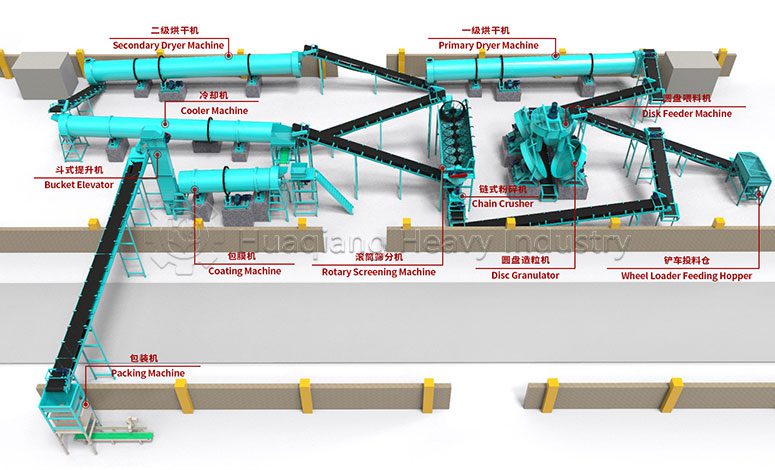
The enemy of bio-organic fertilizer production lines is “invisible temperature.” Unlike the purely physical mixing of BB fertilizers, bio-organic fertilizer disc granulators face a different challenge—how to maintain the activity of functional bacteria during granulation. Microorganisms are extremely sensitive to temperature; their survival rate begins to plummet above 60°C. The value of disc granulation lies in its room-temperature physical forming process—materials naturally roll and agglomerate into spheres on an inclined rotating disc, with the temperature not exceeding 55℃ throughout the process. The sphericity rate can reach over 93%, resulting in uniform granules with high sphericity. However, a design flaw in the production line—such as connecting a high-temperature drying process after granulation—will render all previous efforts futile.
Can two production lines work together? Yes. Organic granules can be produced using a disc granulation line and then used as a raw material in a BB fertilizer production line. These granules can be blended with chemical fertilizer granules in a specific ratio using an NPK blender to create an organic-inorganic compound fertilizer. However, this requires that the particle size of the organic granules match that of the chemical fertilizer granules, and the moisture content must be below 5%. Otherwise, segregation and agglomeration after blending will be more severe than with single BB fertilizer. Production line synergy is not simply a connection of equipment, but a deep understanding and precise control of the two process logics.