How to Choose an Organic Fertilizer Fermentation Compoat Turning Machine?
Choosing a fermentation compost turning machine is actually quite simple. Don’t get bogged down in complicated parameters. The main factors are the size of your site, your production volume, the type of raw materials, and your budget. Three mainstream models each have their suitable scenarios; choosing according to your needs will prevent you from making a mistake.
For small workshops with low production volumes (a few thousand tons of organic fertilizer per year), on open, flat ground, and not wanting to spend money on cement fermentation tanks, choose a wheeled self-propelled turner. This machine is the cheapest, lightweight, and easy to operate; one person can operate it, and no complex construction is required. It’s suitable for loose, non-sticky raw materials like cow manure and straw. The only drawback is its shallow turning depth, about one meter. High-moisture, sticky chicken manure and sludge can easily get tangled in the turning teeth, resulting in incomplete turning. It’s only suitable for small-scale, simple production.
If your site is a greenhouse on flat ground without a fermentation tank, and the raw materials are mixed and unevenly moist, and you want more versatility, choose a windrow compost turning machine. The tracks have good traction, allowing it to navigate muddy or soft material piles without getting stuck or slipping. The turning depth is deeper than wheeled machines, resulting in more uniform fermentation. It can turn chicken and duck manure, pig manure, and mixed straw materials, and features remote control operation, saving time and labor. It’s suitable for small to medium-sized organic fertilizer plants, offering excellent value for money. The only drawback is that the tracks are wear parts, requiring some maintenance costs later.
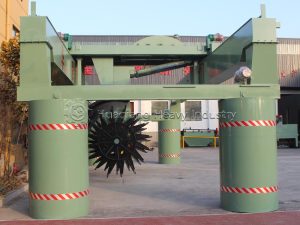
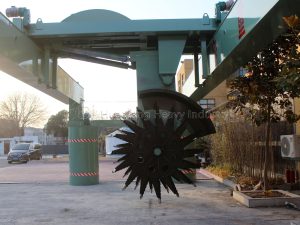
For large, reputable plants with an annual output of over 10,000 tons, using standardized fermentation in enclosed workshops, the trough-type large wheel compost turning machine is the best choice. Cement fermentation troughs need to be prepared in advance. The machine travels along the tracks, turning to a depth of two to three meters, resulting in well-aerated piles, rapid fermentation, and uniform decomposition. It can also be used with a transfer vehicle, allowing one machine to operate multiple fermentation troughs, maximizing utilization. This machine has a low failure rate, is durable and reliable, and has high capacity, making it suitable for long-term stable production. However, the initial construction and equipment investment costs are relatively high.
In conclusion: For small production volumes, budget-conscious operations, and flat terrain, choose wheeled machines; for medium production volumes, diverse materials, and flexible site conditions, choose tracked machines; for large-scale production, standardized plant construction, and prioritizing efficiency and ease of use, choose trough-type machines.