
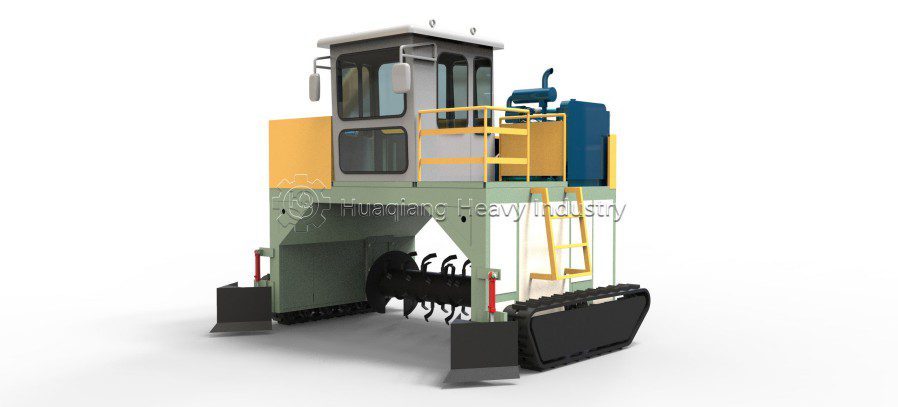
Windrow Compost Turning Machine
The windrow compost turner is a type of ground-based composting equipment featuring a self-propelled design as its core technology. These machines are available in two configurations: crawler-type and wheeled. The crawler-type turner evolved from the wheeled version; its increased ground contact points effectively resolve the slippage issues often encountered with wheeled models during operation, making it the mainstream choice for windrow composting.
The core competitive advantage of the windrow compost turner lies in its flexible “self-propelled windrow” operating mode. Unlike in-vessel or channel-type turners that require the construction of fixed fermentation pits, windrow turners operate directly on material arranged in long rows, eliminating the need for civil engineering investment in pits. The equipment can operate in open-air yards or inside large sheds. For small and medium-sized enterprises facing site constraints, limited investment budgets, or the need for flexible production scaling, the windrow compost turner offers excellent cost-effectiveness.
System Composition and Technical Architecture
The technical architecture of the windrow compost turner can be categorized into the following layers:
(I) Power Layer: Utilizes a diesel engine as the power source, with a power output ranging from 38 kW to 123 hp. The engine’s power drives both the turning drum and the hydraulic pump.
(II) Hydraulic Transmission Layer: Comprises hydraulic pumps, hydraulic valve assemblies, hydraulic motors, and hydraulic cylinders. It facilitates travel drive, drum lifting/lowering, and the control of auxiliary functions.
(III) Mechanical Execution Layer: Consists of the turning drum, turning blades, and the travel mechanism.
(IV) Control Layer: Comprises the operator’s cab, control levers, and hydraulic control valve assemblies.
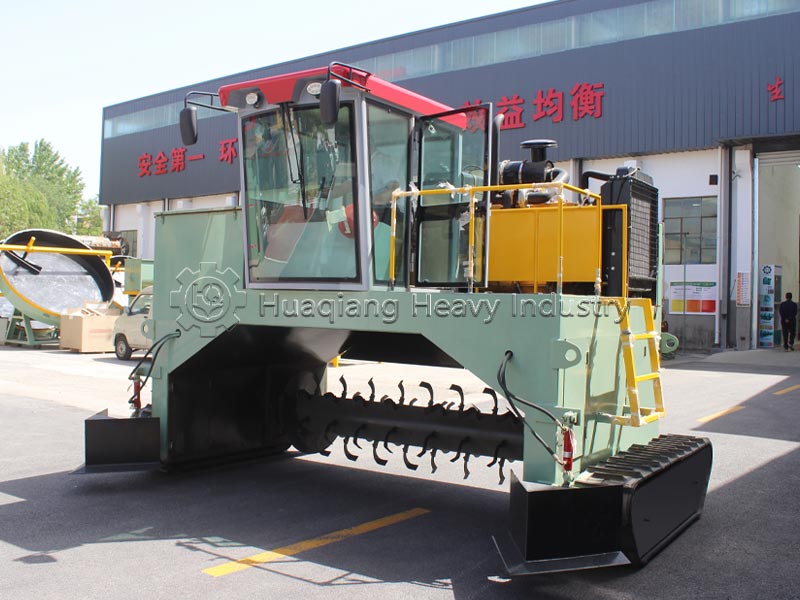
Comparison between tracked and wheeled systems
Windrow compost turners are primarily categorized into two types: crawler-type and wheeled-type.
Crawler-type turners: They exert low ground pressure, making them less likely to sink into soft ground; they offer strong traction, preventing slippage during operation; they are highly maneuverable, capable of making 180-degree turns on the spot; and they possess superior climbing ability. However, the equipment is heavy and relatively expensive.
Wheeled-type turners: They feature a simpler structure and lower cost; they offer faster travel speeds; and they are suitable for operation on solid ground. However, they are prone to slipping when turning high-moisture materials and are less adaptable to different site conditions compared to crawler models.
IV. Comparison with Channel-type Compost Turners
There are significant differences between windrow compost turners and channel-type compost turners:
Civil engineering investment: Windrow systems require no channels, resulting in zero civil engineering costs; channel systems require the construction of fixed fermentation channels.
Site adaptability: Windrow systems can operate outdoors or in greenhouses; channel systems require dedicated fermentation channels.
Operational flexibility: Windrow systems are highly mobile, allowing for easy adjustments to the production layout; channel systems have a fixed layout.
Processing scale: Windrow systems are suitable for small-to-medium-scale production; channel systems are suitable for large-scale, continuous production.
Investment threshold: Windrow systems have a low investment threshold; channel systems have a higher investment threshold.
Industry Applications and Process Compatibility
Windrow compost turners are suitable for small, medium, and large-scale aerobic windrow composting processes. Organic fertilizer industry: processing organic waste such as livestock and poultry manure. Environmental protection industry: aerobic composting of municipal sludge. Agricultural industry: processing crop straw, garden waste, and similar materials. Edible mushroom industry: fermentation of mushroom substrates.

Material Suitability Analysis
Windrow compost turners demonstrate strong adaptability to various materials. High-moisture materials: capable of processing materials with high water content, such as livestock manure and sludge. Viscous materials: crawler-type models are less prone to slipping when handling sticky materials. Fibrous materials: the turning blades can cut through fibrous materials like crop stalks. Compacted materials: capable of breaking up large, compacted clumps within the composting feedstock.
Key Selection Criteria and Procurement Recommendations
When selecting a windrow compost turner, focus on the following key factors:
1. Travel mechanism: Choose based on site conditions. Track-type models are preferable for soft or muddy terrain, while wheeled models are suitable for firm ground.
2. Turning width: Select a model that matches the windrow width (e.g., a 2-meter turning width for a 2-meter-wide windrow, or a 2.8-meter width for a 2.8-meter-wide windrow).
3. Processing capacity: Determine equipment specifications based on daily throughput. Choose small models for 200–400 m³/day, medium models for 400–800 m³/day, and large models for capacities exceeding 1,000 m³/day.
4. Power configuration: Prioritize diesel models that offer ample power and low fuel consumption.
5. Hydraulic system: Prioritize models featuring stable hydraulic operating systems and hydraulic-assisted balancing mechanisms.
6. After-sales service: Select a manufacturer with comprehensive after-sales support to ensure access to installation guidance, operational training, and timely maintenance services.
Models and Specifications of Windrow Compost Turners
| Windrow Compost Turning Machine | |||
Model | HQ-FD 2500 | HQ-FD 2600 | HQ-FD 3000 |
| Width(mm) | HQ-FD 2500 | 2600 | 3000 |
| Height(m) | 500-1000 | 500-1100 | 500-1200 |
| Stack spacing (m) | 1.0-1.2 | 1.0-1.2 | 1.0-1.2 |
| Max Particle Size (mm) | 250 | 250 | 250 |
| Power | R4102 Turbocharged 90HP Diesel Engine | R4105 Turbocharged 105HP Diesel Engine | R6105 Turbocharged 136HP Diesel Engine |
| Rated power speed(r/min) | 2200 | 2200 | 2200 |
| Working speed(m/min) | 6-18 | 6-18 | 6-18 |
| Driving speed(m/min) | 50 | 50 | 50 |
| Processing capacity(m3/h) | 400-600 | 600-800 | 1000-1200 |
| Overall size(m) | 3.64×2.6×2.7 | 3.75×2.6×2.7 | 4.36×2.75×2.95 |